
The Growth Ceiling Every Accounting Firm Eventually Hits

Garrett Moedl
Founding Product Marketer29 June 2026

Recently, we were exploring one question we hear from accounting firms more than almost any other:
How do we continue growing without continually adding operational overhead?
The conversation wasn’t about replacing accountants with AI or chasing the latest technology trend. Instead, it focused on a much more practical challenge facing firms today. Every new client creates additional work. More documents need to be collected, more emails need to be sent, more engagements need to be routed, more statuses need to be tracked, and more people need to coordinate work across disconnected systems.
The result is a growth model in which capacity is determined just as much by operational coordination as by accounting expertise.
If you weren’t able to attend the webinar, this article summarizes the biggest takeaways, the implementation approach we discussed, and a few practical actions your firm can begin taking today. If you’d like to see the complete presentation, including the walkthrough, implementation roadmap, and live examples, you can watch the full webinar on demand.
Growth Doesn’t Stop Because Firms Run Out of Clients
We opened the webinar with a simple question:
Have you turned down a client or delayed onboarding because your team didn’t have the capacity?
For many firms, the answer is yes.
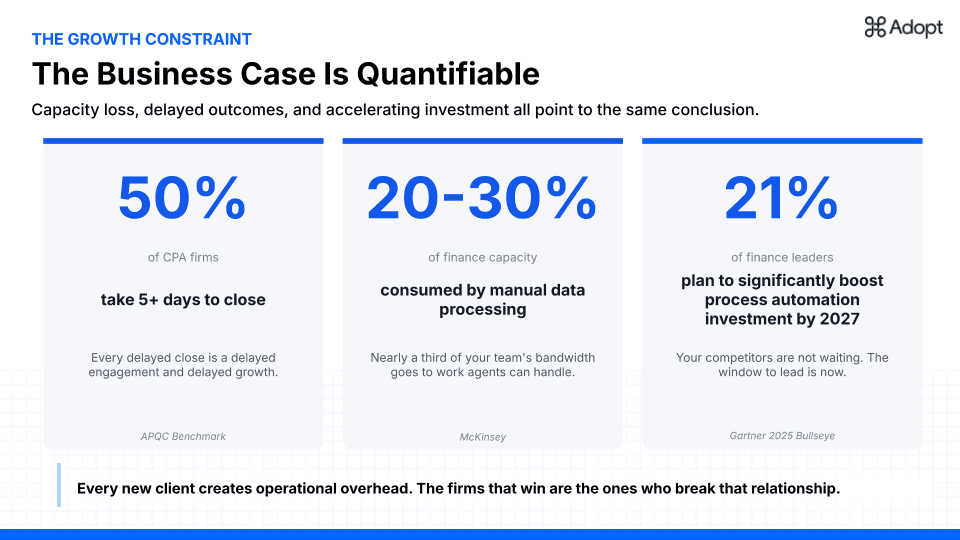
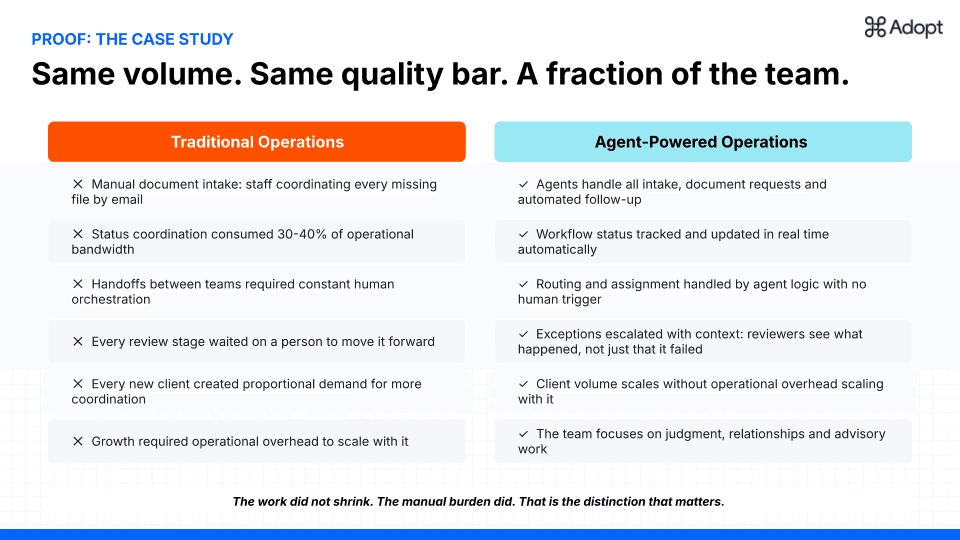
The interesting part is that capacity isn’t always consumed by accounting work. It’s consumed by everything surrounding accounting work. Staff spend hours requesting documents, following up with clients, routing engagements between reviewers, updating spreadsheets, and coordinating progress across multiple systems. Individually these tasks seem small. Collectively they become one of the largest constraints on growth.
As firms grow, those coordination activities grow alongside them. Every additional engagement creates more operational work before it creates meaningful revenue. Eventually firms find themselves hiring simply to manage the administrative burden rather than expanding the services they provide. The challenge isn’t a shortage of demand. It’s the amount of coordination required to deliver the work.
The Hidden Cost of Coordination
One of the biggest themes throughout the webinar was separating professional judgment from operational coordination.
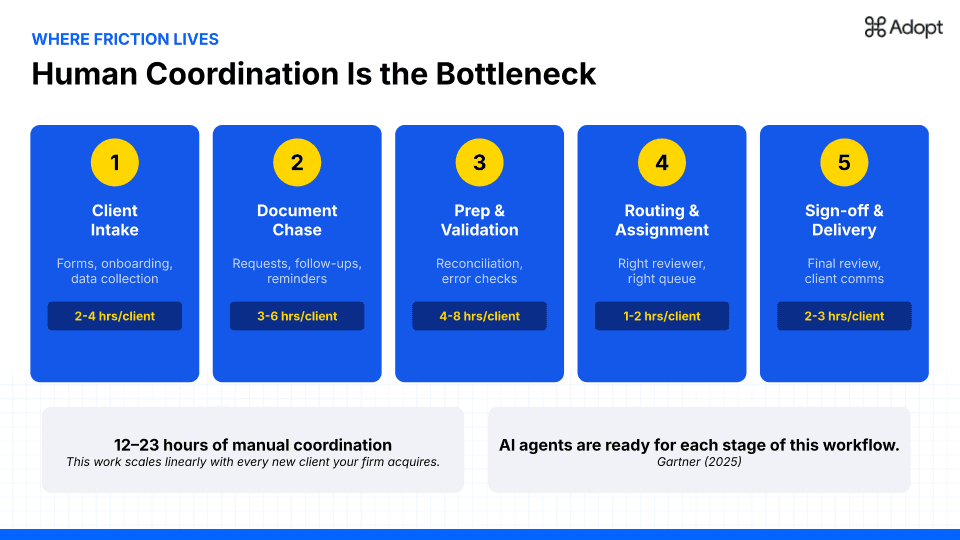
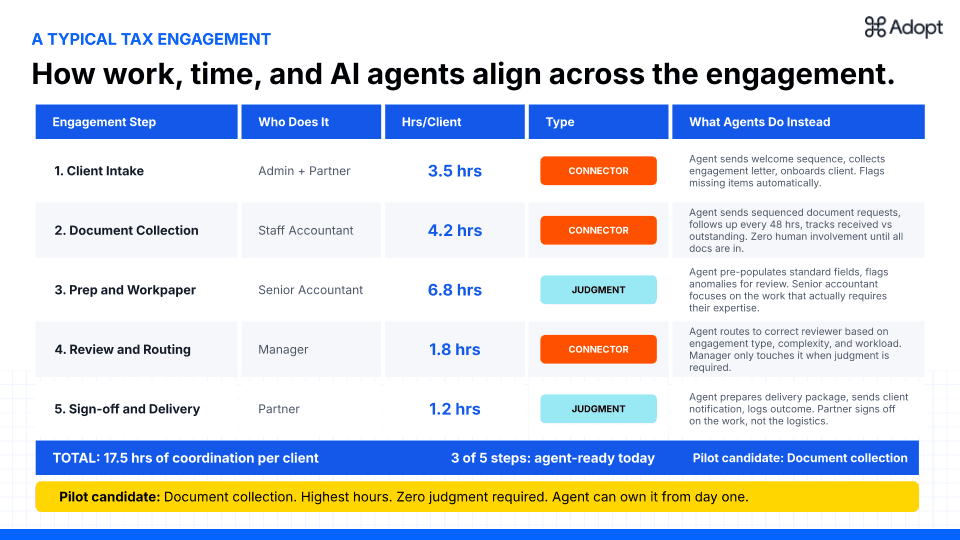
When we mapped a typical accounting engagement from intake through final delivery, we found that firms often spend between 12 and 23 hours coordinating work for every client. Those hours include document collection, status tracking, routing engagements, preparing handoffs, and managing communications between teams.
Very little of this work actually requires an accountant’s expertise.
That realization changes the conversation. Instead of asking how accountants can work faster, firms should begin asking which activities actually require accountants in the first place. Once firms identify the work that is repetitive, rules-based, and operational in nature, they begin to see where AI agents can create immediate value while allowing their teams to spend more time on advisory services, client relationships, and professional judgment.
Why AI Agents Are Different From AI Assistants
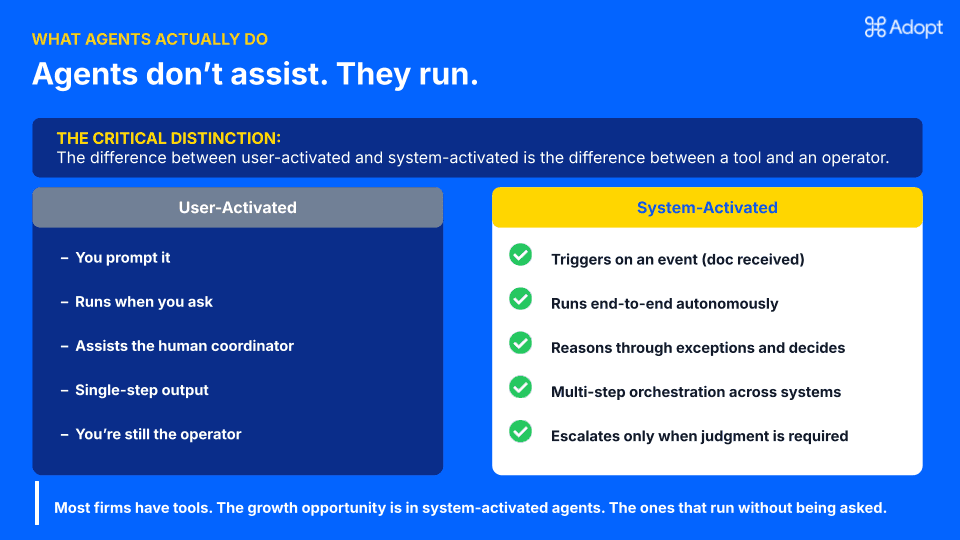
Many firms have already experimented with AI through copilots and chat-based assistants. Those tools can absolutely improve productivity, but they still depend on people to initiate every task. Someone still has to decide when work starts, move it to the next stage, and coordinate what happens next.
AI agents represent a different operating model.
Instead of waiting for someone to ask for help, agents respond automatically to business events. A signed engagement letter can trigger onboarding. Missing documents can automatically generate follow-up requests. Completed work can route itself to the next reviewer. Exceptions can be identified, evaluated, and escalated only when professional judgment is required.
The difference isn’t simply better technology. It’s shifting from AI that helps people perform work to AI that actually executes operational workflows across systems. That shift is what allows firms to begin separating growth from operational overhead.
Start Small and Let Success Build
One of the most common questions during the webinar was where firms should begin.
The answer is almost never to automate everything.
Successful deployments typically start with one workflow that is repetitive, high volume, and requires very little professional judgment. For many accounting firms, document collection becomes the obvious first candidate. It creates significant administrative effort, follows predictable business rules, and produces measurable improvements without disrupting client service.
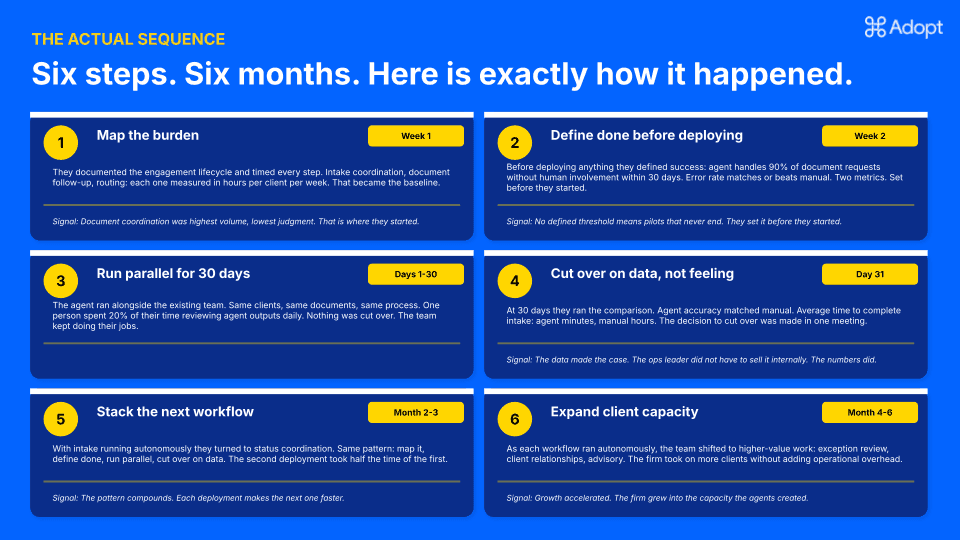
Rather than attempting to transform the entire engagement lifecycle at once, successful firms prove value with one workflow, learn from that deployment, and then expand into routing, validation, client communications, and additional engagement processes. Each successful implementation becomes easier because the organization has already established a repeatable approach.
The Best Deployments Are Measured, Not Assumed
One of the implementation lessons we shared during the webinar was that firms shouldn’t ask employees to simply trust AI. They should let the data make the decision.
The implementation approach begins by documenting the current workflow, defining what success looks like, and then running agents alongside existing processes. During that time, firms compare completion times, accuracy, exception handling, and operational impact before deciding whether to transition the workflow.
This parallel deployment model minimizes disruption while giving leadership measurable evidence instead of assumptions. By the time the first workflow is complete, firms have both the confidence and the internal proof needed to determine where agents create value and where the next opportunity exists.
Capacity Is the Real Return on Investment
One point we continued to reinforce throughout the session is that this conversation should not be centered around reducing headcount.
The real opportunity is creating capacity.
When agents handle document requests, routing, status updates, and other coordination activities, accountants gain more time for client conversations, advisory services, complex reviews, and the work that truly differentiates the firm.
The work doesn’t disappear. The administrative burden does.
That shift allows firms to accept additional clients, improve responsiveness, increase partner leverage, and grow without increasing operational overhead at the same pace.
Three Actions You Can Take This Week
Whether your firm is actively evaluating AI or simply beginning the conversation, there are three practical steps you can take immediately.
1. Map Your Engagement Lifecycle
Document every step from a signed engagement through final delivery. Identify where your team is coordinating work instead of applying accounting expertise. Those coordination points represent your greatest opportunities to improve efficiency and create additional capacity.
2. Identify One High-Volume, Low-Judgment Workflow
Rather than trying to transform every process, select a single workflow that is repetitive and operational in nature. For many firms this will be document collection, engagement status tracking, or routing work between reviewers. Define what success looks like before introducing any new technology so you have a clear way to evaluate the results.
3. Build Your Capacity Baseline
The purpose of a pilot isn’t simply to prove that AI works. It’s to measure the capacity it creates.
Track coordination hours, turnaround times, exception rates, and the amount of professional time returned to your team. Those metrics become your baseline, making it easy to quantify the operational impact of each new workflow and identify where additional opportunities exist across the engagement lifecycle.
The firms that see the greatest success don’t guess where AI delivers value. They measure it, use those insights to prioritize the next workflow, and continue building capacity one process at a time.
Final Thoughts
Accounting firms have spent decades optimizing how accountants perform their work.
The next competitive advantage won’t come from asking accountants to work harder. It will come from removing the operational coordination surrounding them.
The firms that successfully separate coordination from professional judgment will create more capacity, improve client experiences, and build a growth model that isn’t constrained by staffing alone.
If you’d like to explore these concepts in greater detail, including the live examples, implementation roadmap, and deployment strategy we shared during the session, you can watch the

Related Articles

The Cheaper Model Was Right 97% of the Time. We Didn't Ship It.


The AI Controller: Job Description for a Role That Didn't Exist Two Years Ago

See it running on your workflows
Automate your accounting workflows