
Looking for the best iPaaS platform in 2026? Compare enterprise integration architecture, automation depth, governance features, and platform limits.


TD;LR
- iPaaS became the default integration layer not because it was flexible, but because it made execution predictable, auditable, and governable at enterprise scale. That same design choice now defines where it starts to strain.
- Most integration failures today are not caused by broken APIs or missing connectors, but by workflows being forced to handle decisions they were never designed to make.
- AI features inside iPaaS change how workflows are authored and how data is interpreted, but they do not change the execution model. Decisions still have to be pre-modeled, and ambiguity still escapes the workflow.
- As workflows grow into branching decision trees, human escalation quietly becomes the real control layer, slowing execution and increasing operational risk.
- This pressure gives rise to a separate control layer that sits above execution platforms, evaluates intent, coordinates actions across systems, and decides what should happen next when outcomes diverge from expectations.
- Adopt AI fits into this architecture as that control layer, not by replacing iPaaS, but by deciding how and when execution platforms should be used when workflows alone are no longer sufficient.
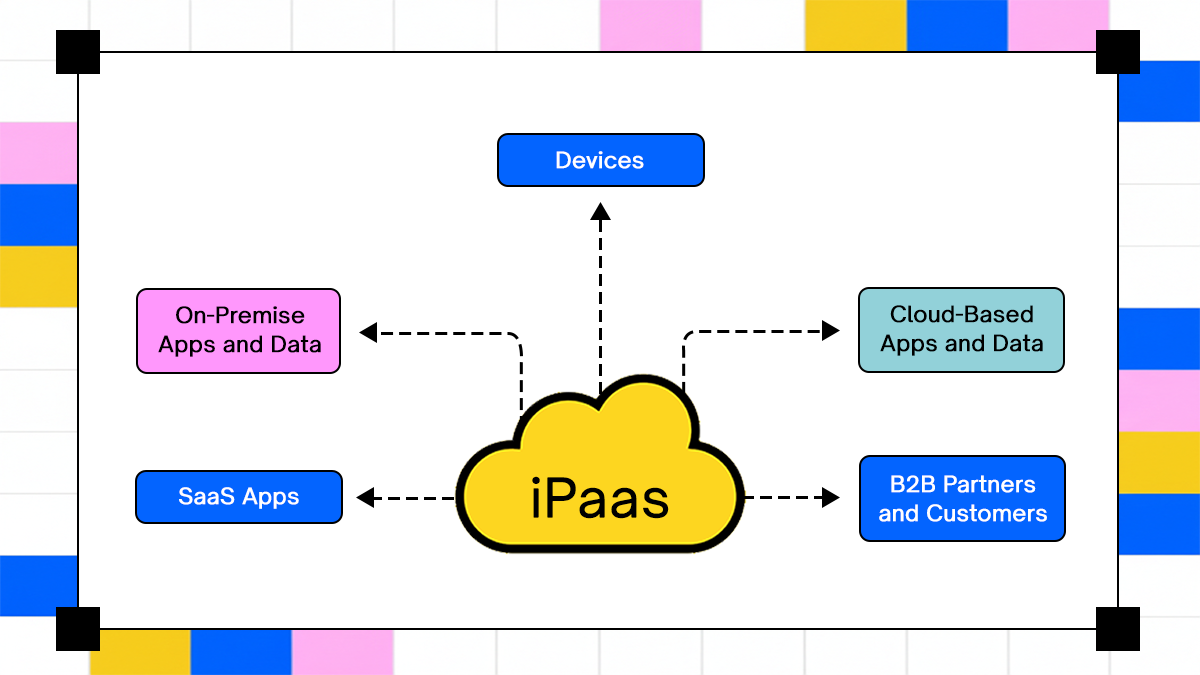
Integration Platform as a Service (iPaaS) is a cloud-centric model for connecting disparate systems, enabling applications and data across SaaS, on-premises, and legacy environments to exchange information through a shared integration layer. Instead of custom point-to-point code, iPaaS uses managed connectors and pre-defined workflows to handle real-time data flows, batch jobs, and API interactions under unified operational control. Industry analysts estimate that the global iPaaS market was valued at roughly USD 9.16 billion in 2024 and is projected to grow to more than USD 47 billion by 2032, reflecting continuing enterprise reliance on centralized integration solutions.
Practitioners on platforms such as Reddit often highlight why integration remains hard in practice. In discussions about tooling, developers contrast building integrations manually with using ready-made platforms such as Workato or MuleSoft to simplify connectivity across CRM, ERP, and other systems, noting that iPaaS tools accelerate delivery and reduce repetitive work compared to custom scripting.
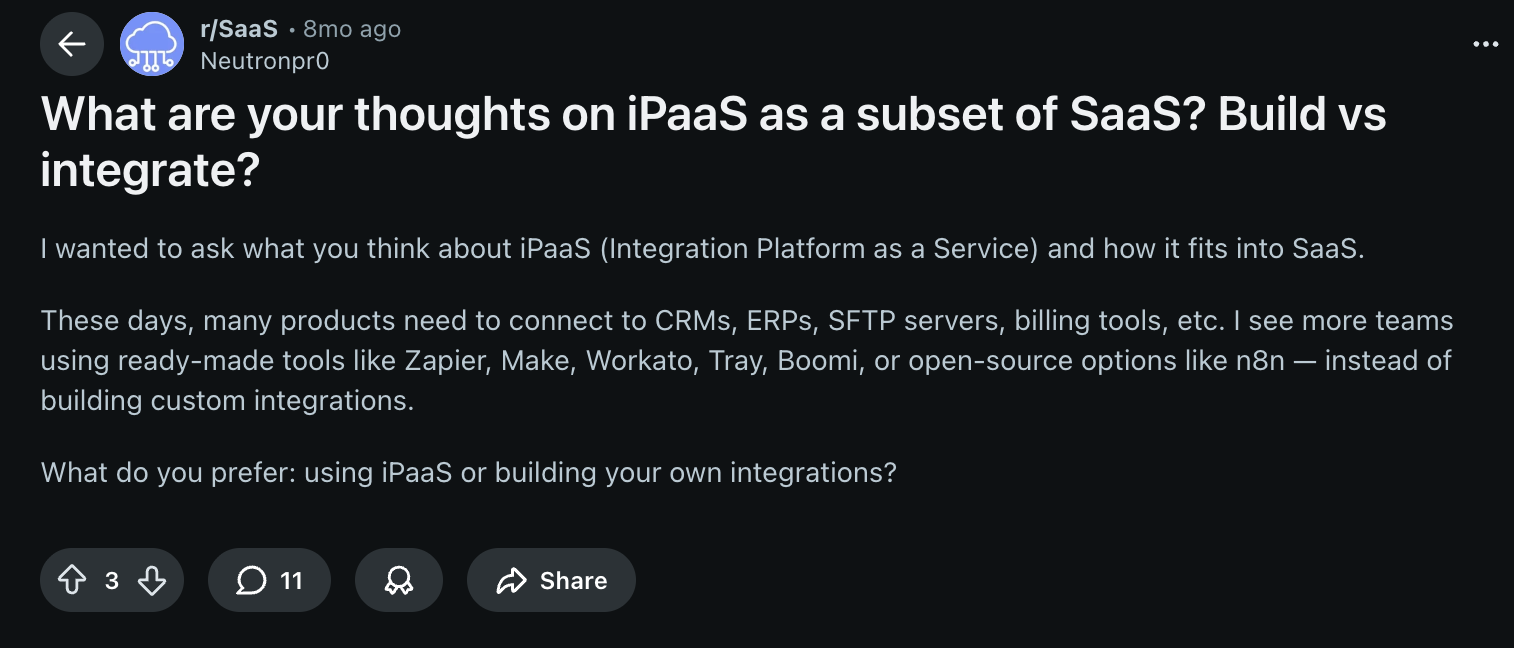
These exchanges surface a persistent tension: integration workloads proliferate faster than traditional approaches can scale, even as teams seek ways to manage variability without overloading execution logic.
This article examines where iPaaS excels and where its execution-focused design reaches its limits, especially as enterprises seek to coordinate across systems and complex decision paths. It explains why adding assistive features within iPaaS does not alter the underlying execution model, introduces the idea of a separate decision-coordinating layer above execution platforms, and clarifies how that layer fits within a layered enterprise architecture without replacing iPaaS. Readers will leave with a structured understanding of integration architecture in modern enterprises, the boundaries of deterministic workflows, and how to think about coordination across systems in a maintainable way.
What is iPaaS and How It Works?
Integration Platform as a Service exists to centralize how systems exchange data and trigger actions across application boundaries. It provides a shared execution environment where integrations run outside individual application codebases. This separation allows integration logic to be managed, observed, and controlled independently of the systems it connects to.
An iPaaS platform executes pre-defined workflows. These workflows are authored ahead of time as explicit control flows that define each step, conditional branch, transformation, and failure path. When an event occurs, the platform evaluates the workflow definition and executes it exactly as specified. The system does not infer intent or choose between actions beyond what has already been encoded into the flow.
Connector ownership is a core characteristic of iPaaS. Vendors maintain adapters for common SaaS platforms, databases, and internal services. These connectors handle authentication methods, pagination behavior, rate limits, and schema differences. From an operational standpoint, this shifts integration maintenance from application teams to the platform layer, reducing the need for repeated implementation effort.
iPaaS platforms also have execution concerns. They manage retries, backoff behavior, timeouts, state persistence, and failure reporting. When a workflow step fails, the platform determines whether to retry, pause, or escalate based on pre-configured rules. This makes iPaaS suitable for integrations that require traceability and predictable behavior across environments.
What iPaaS does not handle by design
What iPaaS does not provide is runtime decision-making outside those definitions. It does not interpret ambiguous requests, it does not select goals, and it does not adjust behavior based on context that has not been explicitly modeled. Every outcome is bound by what the workflow author anticipated. These boundaries explain both the success of iPaaS and the conditions under which it begins to strain.
Why iPaaS Became the Standard Integration Layer for Enterprises
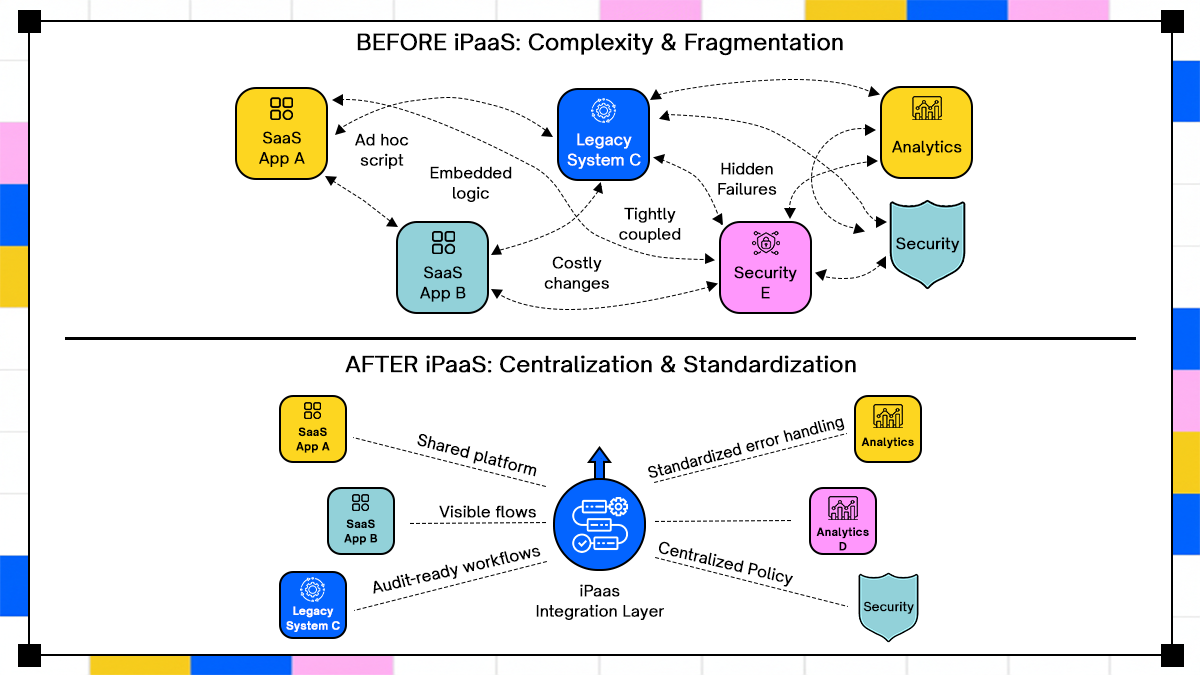
The widespread adoption of iPaaS followed a structural change in how organizations built and purchased software. As enterprises adopted large numbers of SaaS applications, integration complexity increased faster than application complexity. Each new system introduced multiple data dependencies across finance, operations, analytics, and security functions.
Before iPaaS, integration logic often lived inside application code or ad hoc middleware services. Teams wrote scripts, background jobs, or service-to-service bridges to keep systems in sync. These integrations were tightly coupled to application lifecycles, difficult to observe, and expensive to change. When failures occurred, diagnosing the root cause required deep knowledge of individual implementations.
iPaaS addressed this by pulling integration logic into a shared platform. Instead of embedding integrations everywhere, organizations centralized them. This made data flows visible, standardized how failures were handled, and created a single place to apply access controls and operational policies. Platform teams could treat integrations as infrastructure rather than application-specific side effects.
Another factor behind iPaaS adoption was organizational fit. Integration work spans multiple teams and rarely belongs cleanly to a single product group. iPaaS provided a neutral layer where engineering, operations, and business systems teams could collaborate without forcing ownership into one codebase. Operational reuse also played a big role. Retry behavior, credential handling, logging, and alerting no longer had to be reimplemented for every integration. Once these mechanisms existed at the platform level, teams could focus on defining flows instead of rebuilding execution scaffolding.
Most importantly, iPaaS is aligned with enterprise risk models. Deterministic workflows, explicit mappings, and predefined error paths supported audit requirements and change management processes. The system behaved in ways that could be inspected after the fact, which mattered more than flexibility in many regulated environments.
By the mid-2020s, iPaaS became a foundational layer in enterprise architectures. It did not reduce complexity so much as contain it. That containment worked well as long as integration problems remained predictable and inputs stayed structured. The next sections examine what happens when those assumptions no longer hold.
Where iPaaS Starts to Break Down at Scale
As integration estates grow, the deterministic model that makes iPaaS dependable begins to surface structural limits. These limits are not caused by poor implementation or vendor quality. They emerge from how iPaaS systems are designed to operate.
At a small scale, most integrations can be expressed as linear flows. An event occurs, data is transformed, an action is triggered, and the workflow completes. As business processes become more interconnected, the number of conditions that affect those outcomes increases. Each condition must be accounted for explicitly.
A common example appears in order processing. A single order event may require different downstream actions depending on inventory availability, customer tier, regional compliance rules, payment status, or fraud signals. In iPaaS, each of these variations becomes a branch in the workflow. Over time, the flow expands sideways rather than forward.
This results in workflows that resemble decision trees rather than processes. The logic is still explicit, but understanding the full behavior requires tracing many possible paths. Changes become risky because modifying one branch can affect others in non-obvious ways. Exception handling introduces a second layer of complexity. iPaaS platforms assume that failures fall into recognizable categories, such as network timeouts, rate limits, or authentication errors. These are handled through retries, delays, or compensating steps.
Human escalation as a default resolution path
When workflows encounter conditions that cannot be resolved programmatically, they escalate to humans. Over time, this becomes the default mechanism for handling ambiguity. Operators review payloads, interpret intent, and decide what should happen next. The platform executes the mechanics, but humans supply the decision-making.
iPaaS workflows operate in isolation, and each integration instance executes independently. There is no native concept of global coordination, such as deciding which workflow should take precedence when multiple systems attempt conflicting actions. Any cross-workflow reasoning must be implemented manually, often by adding yet another layer of orchestration.
These issues do not indicate misuse of iPaaS, but rather reflect the limits of a system that executes what it is told, but cannot decide what should be done when conditions fall outside predefined logic.
Why AI Features Inside iPaaS Do Not Change the Execution Model
To address growing complexity, many iPaaS platforms have added AI-assisted features. These additions are often described as making workflows easier to build or data easier to process. In practice, they operate within the same execution constraints.
Most AI features in iPaaS appear at design time. They assist users by suggesting field mappings, inferring schemas, or generating sample transformations. These capabilities reduce setup effort, but they do not change how workflows behave once deployed. The runtime still follows a fixed control flow.
Some platforms introduce AI-powered steps at runtime, such as text classification or the extraction of structured data from documents. These steps act as functions within a predefined workflow. They produce outputs that must still be handled through conditional logic authored in advance.
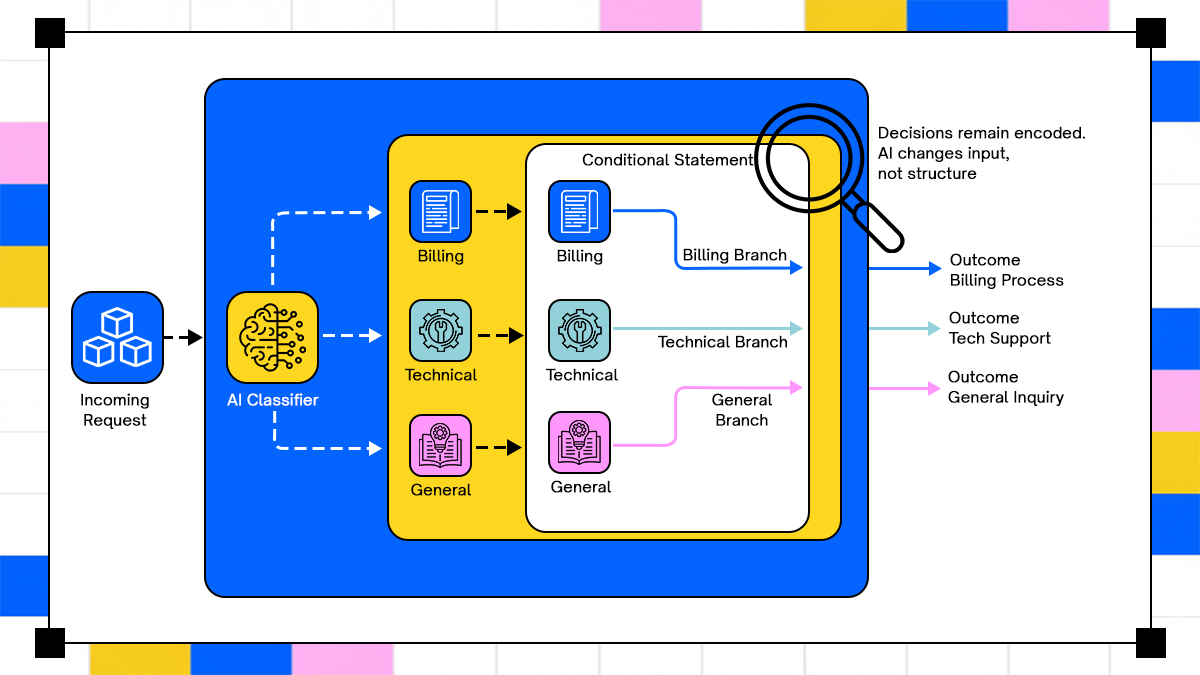
For example, a workflow might classify an incoming request as billing-related, technical, or general. Each classification maps to a different branch. If the classification is ambiguous or incorrect, the workflow has no way to reassess its goal. It proceeds according to the logic that was defined before execution. This highlights an important distinction. AI can generate signals, but it does not decide outcomes unless the system is designed to delegate decision-making. In iPaaS, decisions remain encoded in conditional statements. AI changes the inputs to those conditions, not the structure itself.
There is also a scope limitation, i.e., AI features inside iPaaS typically operate within a single workflow instance. They do not evaluate broader system context, such as:
- concurrent workflows affecting the same records
- operational priorities across departments
- cumulative effects of repeated actions
Each execution remains isolated, and the platform does not reason across integrations unless that coordination has been explicitly modeled, which reintroduces the same branching and maintenance challenges discussed earlier.
As a result, adding AI to iPaaS improves certain tasks, such as data handling or workflow authoring, but it does not alter the fundamental execution model. The system still requires humans to define intent, enumerate decision paths, and handle ambiguity when reality diverges from predefined logic. This is why the limitations of iPaaS persist even as AI features are introduced.
The Emergence of Agentic Control Layers
As integration systems became increasingly variable, teams began to see a recurring failure pattern. Deterministic workflows continued to execute correctly, yet outcomes increasingly required judgment that could not be encoded in advance. Extending workflows further did not resolve this; it only increased branching and maintenance costs.
The response that emerged was architectural rather than tool-driven. Instead of asking execution systems to decide, teams separated decision-making into its own layer. Execution platforms continued to do what they were built for. A new layer took responsibility for determining what should happen next.
What A Control Layer Actually Does
A control layer does not replace existing platforms. It operates by observing inputs, evaluating context, and issuing instructions to systems that already know how to act.
In practical terms, this means the control layer is responsible for:
- Interpreting requests that are incomplete or ambiguous
- Determining which systems are relevant to a given situation
- Sequencing actions across those systems
- Reassessing decisions when outcomes differ from expectations
Example: Operational Request Handling
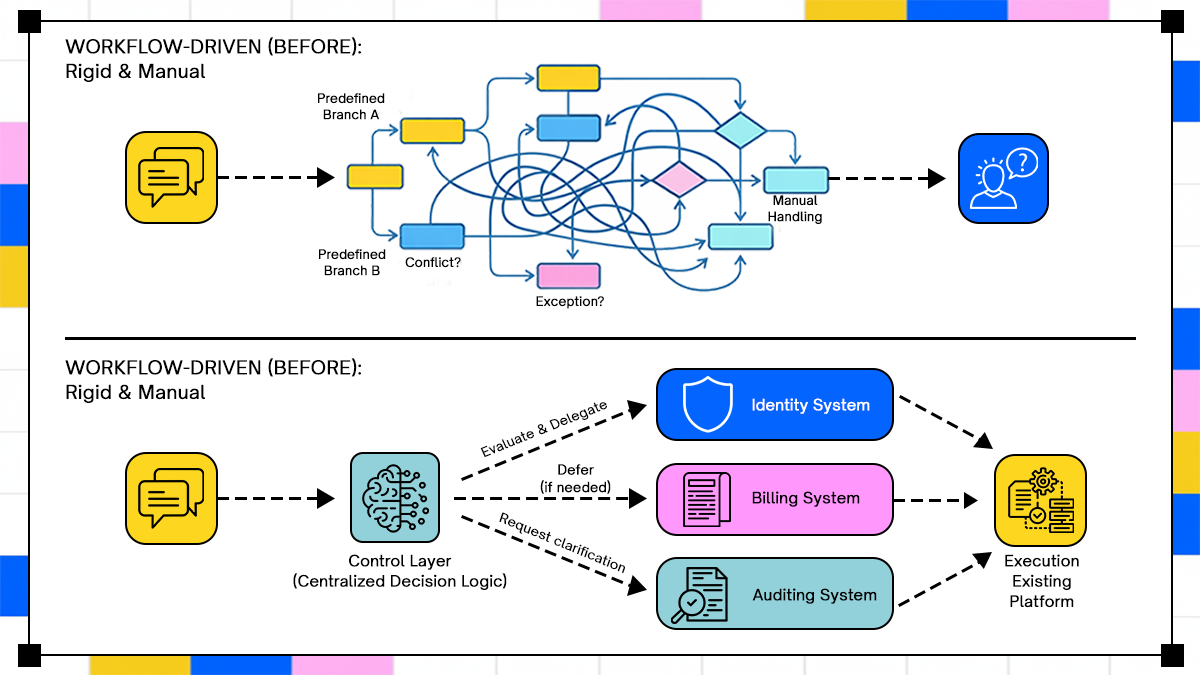
Consider an internal request submitted via a chat tool requesting a temporary access change. The request references a user, a role, and a time window, but does not specify which systems are involved or whether the request conflicts with existing policies. In a workflow-driven model, this requires predefined branches for every possible combination. In practice, many cases fall outside those definitions and require manual handling.
With a control layer in place, the system evaluates the request, determines which identity, billing, and auditing systems are affected, and decides how to proceed. It may delegate access changes to one system, defer others, or request clarification before continuing. Each execution step is handled by existing platforms. The decision logic remains centralized.
How Exception Handling Changes
In deterministic workflows, exceptions are terminal. A step fails, the workflow retries, escalates, or stops. All possible responses must be defined in advance. A control layer treats exceptions as signals rather than endpoints. When an action fails, the system evaluates the outcome and decides whether to attempt an alternative, adjust sequencing, or request human input. Execution systems still fail deterministically. The difference is that failure no longer ends the process by default.
Why This Layer Exists At All
The emergence of control layers is driven by the cost of pushing decision-making into systems built to execute, not to decide. Once decision logic is separated, execution systems become simpler to maintain. Control logic becomes easier to evolve. Responsibilities are made explicit rather than implied by the workflow structure. This separation is what makes the next section possible without misclassifying platforms.
Where Adopt Fits in the Enterprise Automation Stack
Adopt AI does not operate as an execution system. It does not own integration runtimes, maintain connector libraries, or manage retries at the transport layer. Those responsibilities remain with platforms such as iPaaS tools, RPA systems, or internal services.
This distinction matters because execution platforms are evaluated on stability, throughput, and operational controls. Adopt is evaluated on how it decides what should happen when conditions are unclear, inputs are incomplete, or multiple systems are involved. Adopt interacts with execution platforms through their existing interfaces. It issues instructions and observes outcomes. It does not replace the mechanics of how actions are carried out.
The responsibility Adopt takes on
Adopt’s responsibility sits entirely in the decision layer. It evaluates intent, determines which systems should be involved, and sequences actions across those systems based on the current context.
That responsibility includes:
- Interpreting requests that are not fully specified
- Identifying which systems are affected by a given situation
- Deciding the order in which actions should occur
- Reassessing decisions when outcomes differ from expectations
None of these tasks requires Adopt to execute API calls directly. They require it to coordinate systems that already can.
Example: Multi-System Account Change
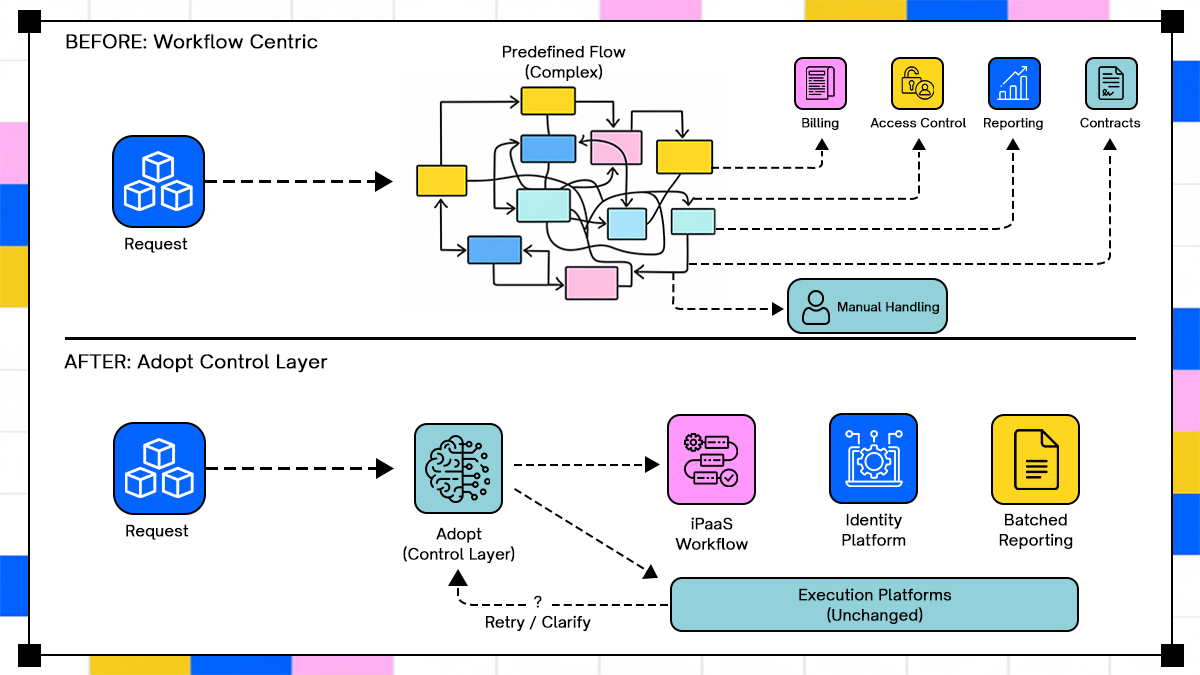
Consider a request to downgrade a customer account that arrives through a support channel. The request references a plan change, but does not explicitly list the downstream effects. Billing, access control, reporting, and contract systems are all implicated. In a workflow-centric model, this requires a predefined flow that accounts for every possible account state and exception. Any deviation results in manual handling.
With Adopt acting as a control layer, the system evaluates the request, determines which systems must change, and delegates actions accordingly. Billing updates may be executed through an iPaaS workflow. Access changes may be handled through an identity platform. Reporting updates may be deferred or batched.
If one action fails, Adopt evaluates the result and determines whether to retry through a different path, pause execution, or request clarification. The execution platforms remain unchanged, and the coordination logic lives elsewhere.
How Adopt Handles Exceptions Differently
In deterministic workflows, exceptions are terminal by default. The system retries, escalates, or stops based on predefined rules and every response must be anticipated. Adopt treats exceptions as inputs into further decision-making. A failed action does not automatically end the process. Instead, the system evaluates the failure in context and decides what to do next. That decision may involve alternative actions, delayed execution, or human involvement.
This does not eliminate governance. It shifts where judgment is applied. Execution platforms still enforce access controls and retry policies. Adopt decides whether continuing makes sense.
What Adopt deliberately does not do
Adopt does not attempt to absorb execution responsibilities. It does not try to become a universal integration runtime or replace existing platforms. This boundary is deliberate. Execution systems are built for reliability and predictability. Decision systems are built for variability and coordination. Blending these roles creates the same complexity problems discussed earlier.
iPaaS and Adopt as a Layered Enterprise Model
In a layered model, iPaaS remains responsible for executing stable, well-understood integrations. These include data synchronization, event propagation, and transactional processes that benefit from explicit control flows.
Adopt operates above this layer. It does not redefine how integrations are built. It decides when they should run and how they should be combined in response to real-world situations. This separation reduces pressure on both systems. iPaaS workflows become simpler and easier to maintain. Decision logic evolves without requiring constant rewrites of execution flows.
What Stays Inside Ipaas
iPaaS continues to own:
- connector management and authentication
- execution runtime and state
- retries, backoff, and failure reporting
- observability at the integration level
These concerns do not benefit from contextual decision-making. They benefit from determinism and consistency. Keeping them inside iPaaS preserves reliability and auditability.
What moves into the control layer
The control layer absorbs logic that does not scale well inside workflows, including:
- handling requests that vary in structure or intent
- coordinating actions across multiple systems
- managing exceptions that require judgment rather than retries
- deciding when human input is necessary
Reframing the Enterprise Automation Platform Landscape
With this architecture in place, the platform landscape must be described differently. Grouping all automation-related tools under a single category obscures important distinctions and leads to incorrect comparisons.
iPaaS platforms belong to the execution category. Their primary differentiators include connector coverage, runtime reliability, observability, and operational tooling. Examples in this category include platforms that specialize in managing API interactions, data movement, and event-driven workflows. These systems are evaluated based on how well they execute known processes.
Agentic control layers belong to a separate category. Their focus is not on connectors or runtimes but on decision-making and coordination. They evaluate inputs, determine intent, and sequence actions across systems. Their value is measured by how they handle variability, ambiguity, and cross-system dependencies.
Treating these categories as interchangeable creates confusion. Comparing an agentic control layer to an iPaaS platform based on connector count or throughput misses the point. Likewise, expecting an iPaaS platform to provide system-wide reasoning misunderstands its design constraints.
In practical terms, enterprise architectures increasingly include both. iPaaS platforms remain central to integration strategy. Agentic control layers are introduced where workflows become difficult to maintain due to branching complexity, unstructured inputs, or frequent exceptions. This reframing also affects how platform decisions are made. The question is no longer which tool replaces another. The question becomes where decision-making should live and which systems are responsible for execution. Clear answers to those questions lead to architectures that scale without accumulating unmanageable logic.
The final section will consolidate this perspective into an enterprise strategy for the coming years, focusing on how teams evolve their automation stacks without destabilizing existing systems.
Conclusion
iPaaS remains a foundational part of enterprise integration architecture because it solves a well-defined, specific problem. It executes predefined processes across systems with predictable behavior, clear failure handling, and strong operational controls. Those characteristics are why it became the standard integration layer and why it continues to be relied on in production environments.
A layered architecture provides clearer boundaries. Execution systems continue to do what they are built for. Decision-making is handled separately, where context can be evaluated, and outcomes reassessed without forcing all reasoning into static workflows. This separation reduces pressure on both layers and makes change easier to manage.
Within this model, platforms like Adopt AI fit as control layers rather than execution replacements. They coordinate across systems, evaluate outcomes, and decide when execution should continue, change direction, or involve humans. iPaaS remains the execution backbone. The control layer determines how and when it is used.
The result is not fewer platforms or simplified tooling, but it is a clearer responsibility. Execution remains deterministic where it should. Decision-making moves to a layer designed to handle variability. For enterprises planning integration architectures beyond 2026, that clarity matters more than expanding workflows or replacing platforms.
FAQs
1. What Problems Is iPaaS Actually Built To Solve?
iPaaS is built to execute predefined integration logic across systems reliably and in a way that is observable. It centralizes data movement, event handling, retries, and error reporting so integrations do not have to live inside application code. It works best when processes are predictable, inputs are structured, and outcomes can be fully described in advance.
2. Why Do Ipaas Workflows Become Difficult To Maintain At Scale?
As integrations take on more responsibility, workflows are often extended to handle decisions, exceptions, and cross-system coordination. This causes branching logic to grow, increases reliance on human escalation, and makes changes risky. The issue is not the platform, but the attempt to use deterministic workflows for problems that require judgment.
3. Do AI Features Inside iPaaS Remove the Need for Manual Intervention?
No. AI features inside iPaaS assist with authoring workflows or interpreting data, but they do not change where decisions are made. Execution still follows predefined control flows, and situations that fall outside those flows still require human input. The execution model remains unchanged.
4. How Does Adopt Fit Into an iPaaS-based Integration Architecture?
Adopt AI fits as a control layer above iPaaS, not as a replacement for it. It evaluates intent, coordinates actions across systems, and decides how execution platforms should be used when workflows alone cannot handle variability. iPaaS continues to execute integrations, while Adopt handles decision-making and coordination.

.svg)
.svg)

Browse Similar Articles
Accelerate Your Agent Roadmap
Adopt gives you the complete infrastructure layer to build, test, deploy and monitor your app’s agents — all in one platform.