
What Is the Month-End Close? Every Step, Explained

Sunil Neurgaonkar
Marketing31 October 2026
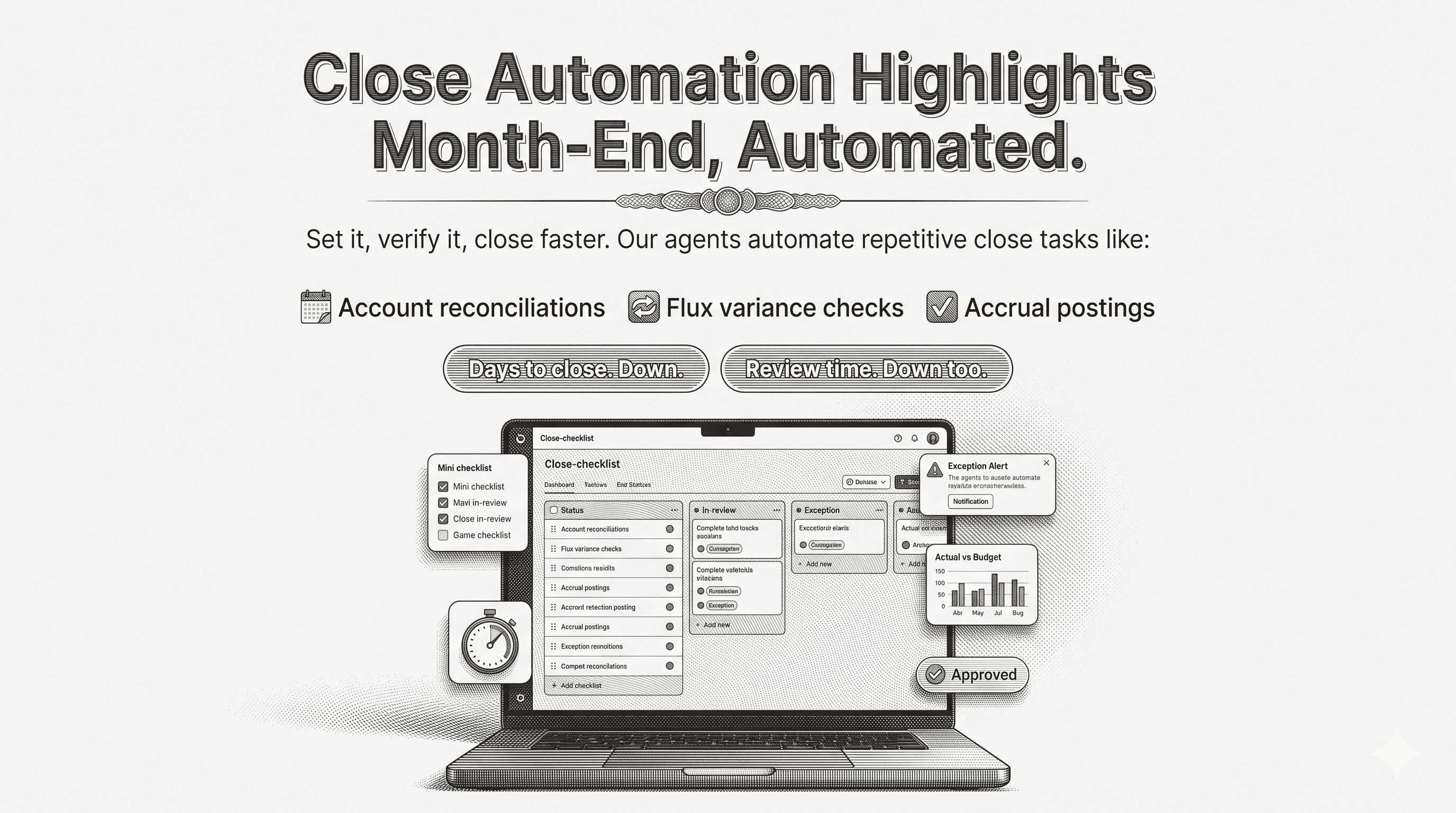
The month-end close is the set of tasks a finance team completes after a month ends to turn raw transactions into financial statements it can stand behind. The team checks cutoff, reconciles accounts, records adjustments, reviews the result and locks the period. Statements come out the other side.
This guide walks through the month-end close process in order, names who usually owns each step, and shows where a close loses days. If you need the task-by-task template, use the month-end close checklist. This post explains why each step exists.
Why the close exists
A ledger fills up all month with entries that are not yet right. Bank activity has not matched to invoices. Expenses sit unrecorded because a bill has not arrived. A prepaid balance still shows the full amount. The close fixes those, so that revenue, expense and balances describe the month that just ended.
Leaders, lenders and auditors read the output. A late or wrong close means decisions on stale numbers.
The steps of the month-end close process
1. Set the cutoff
The team agrees on the last day of activity that belongs to the month and confirms that sub-ledgers (payables, receivables, payroll) have stopped accepting entries for it. Everything after cutoff belongs to the next period. A loose cutoff produces the errors that take longest to find later.
2. Complete sub-ledger work
AP posts the last bills and confirms the open-bill list. AR applies cash and confirms the open-invoice list. Payroll posts the final run. Each owner closes their own sub-ledger before the general ledger can be trusted.
3. Reconcile accounts
A preparer compares the balance on the ledger to an outside source: the bank statement for cash, the processor report for payment platforms, the vendor statement for payables, the loan schedule for debt. Differences become reconciling items, and each one needs an explanation or a correction. See account reconciliation for the full method.
Reconciliation is where most close hours go. Pulling statements, matching lines and chasing the odd items take longer than any other step.
4. Record accruals and adjustments
The team books expenses incurred but not yet invoiced, revenue earned but not yet billed, and the month's share of prepaid balances. Depreciation and amortization post here too. Many accruals reverse at the start of the next month, so the real invoice does not double count.
5. Handle intercompany and multi-entity items
Companies with more than one entity match intercompany balances, translate currencies where needed and eliminate the internal activity before consolidating. A mismatch between entities stops the consolidation until someone finds the source.
6. Review the trial balance
The controller or senior accountant reads the trial balance for accounts that look wrong. A review that compares each balance to prior months and to budget catches misposted entries and missing accruals. Variance analysis, sometimes called flux, explains what moved and why.
7. Prepare the statements
The team builds the income statement, balance sheet and cash flow statement from the reviewed trial balance, plus the supporting schedules management asks for.
8. Review, approve and lock
A reviewer who did not prepare the work signs off. Then the period locks, so later entries cannot change a closed month without a deliberate reopen. A named preparer and reviewer on each account give the auditor a clear record.
Who owns what
| Step | Typical owner |
|---|---|
| Cutoff | Controller |
| Sub-ledger work | AP, AR and payroll leads |
| Reconciliations | Staff accountants |
| Accruals and adjustments | Senior accountant |
| Intercompany | Senior accountant or consolidation lead |
| Trial balance review | Controller |
| Statements | Controller or FP&A |
| Final approval and lock | Controller and CFO |
Smaller teams collapse this table into two or three people, and the same person often prepares and reviews. That works until an error slips through, which is why a second pair of eyes at step 8 matters.
Where a close loses days
Three places account for most delays.
- Late inputs. A bill, a statement or an approval arrives after the date the calendar assumed. Each late item pushes everything that depends on it.
- Manual reconciliation. Downloading statements and matching lines by hand scales with account count, not with importance. A team with fifty accounts spends days on accounts that never have a problem.
- Rework after review. The reviewer finds an issue, and the preparer has to redo an account that other steps already used.
A close calendar that lists each task with an owner and a dependency makes these delays visible before they happen.
How agents change the process
The structure of the close stays the same. Who does the preparation changes. Adopt's agents pull the statements, match the lines, prepare the reconciliations and flag the exceptions. A person reviews, with separation of duties, and signs off. The lock and the sign-off stay with your team. Nothing posts to your books without a human approval.
That moves your staff from assembling the reconciliation to reviewing it, which is where their judgment counts.

Related Articles
Why AI Finance Tools Fail on Legacy Systems and No-API Bank Portals


What Is Agentic Finance? A Plain-English Guide for Finance Leaders

See it running on your workflows
Automate your accounting workflows