The Month-End Close: The Complete Guide

Deepak Anchala
Co-Founder and CEO, Adopt AISep 7, 2026
Every finance team already has a close process. There is a checklist, a calendar, a set of reconciliation workbooks that have survived three controllers, and a person who knows which bank portal needs the second password. The close happens every month, which makes it the most rehearsed process in the company.
And it is still late. Or it lands on time because three people gave up a weekend, which is the same thing on a different invoice.
That is the subject of this guide. Not what the month-end close is, which takes a paragraph, but how the work actually moves through a finance team: every step in dependency order, who does what on which day, where the hours actually concentrate, and which levers shorten the close versus which ones just move the pain. It is written for the controller who owns the calendar and the CFO who answers for the date.
Scope note: this guide covers closing a single company's own books, including multi-entity consolidation. If you are a firm closing books for many clients, the mechanics below still hold, but the per-client variability problem changes the economics; see Accounting Automation That Survives Contact With a Real Firm for that side of the work.
What the month-end close is
The month-end close is the recurring process of finalizing a company's books for the period: recording every transaction in the right month, reconciling every balance sheet account to evidence, posting the adjusting entries that accrual accounting requires, and producing financial statements a responsible person is willing to sign.
The output is not "the numbers." The output is a reconciled trial balance with support behind every balance, and the statement set built from it: balance sheet, income statement, cash flow. Everything else in the close exists to make that artifact true.
The close exists because of accrual accounting. On the last day of the month, the ledger does not yet reflect economic reality: expenses have been incurred that no invoice has arrived for, revenue has been billed that has not been earned, payroll spans the period boundary, and equipment quietly consumed another month of its useful life. The close is the set of adjustments and verifications that move the books from "what got entered" to "what actually happened."
Enterprise teams and software vendors often call the wider cycle record to report (R2R): capture transactions, close the books, consolidate, report. The month-end close is the middle of that cycle, and it is where the hours concentrate.
One distinction worth fixing early, because it shapes everything downstream: the close has a preparation layer and a judgment layer. Preparation is pulling statements, matching transactions, building reconciliations, drafting accruals, and populating schedules. Judgment is choosing treatments, deciding what an anomaly means, and signing. The preparation layer is where the time goes. The judgment layer is where the value is. Most of the misery in a slow close is skilled people doing preparation because nobody else, and nothing else, could reach it.
The close, step by step
Close checklists vary by company, but the underlying dependency order does not, because it is set by how the numbers feed each other. Here is the whole process in that order, with the phases named the way close calendars usually name them. Business-day notation: BD1 is the first business day after month end, BD-3 is three business days before it.
| Phase | What happens | Typical window |
|---|---|---|
| 0. Pre-close | Daily cash matching, subledger hygiene, chasing documents before the deadline exists | All month, especially the last week |
| 1. Cutoff and subledger close | AP, AR, payroll, inventory, fixed assets closed for the period, cutoff enforced | BD-2 to BD2 |
| 2. Cash and balance sheet reconciliations | Every bank, card, and clearing account tied to evidence | BD1 to BD3 |
| 3. Accruals and adjusting entries | Accrued expenses, prepaids, depreciation, deferrals, payroll accrual | BD2 to BD4 |
| 4. Revenue and cost recognition | Revenue recognized per policy, deferred revenue rolled forward, COGS trued up | BD2 to BD4 |
| 5. Intercompany and consolidation | Eliminations, FX translation, entity rollup (multi-entity companies) | BD3 to BD5 |
| 6. Trial balance review and flux | Preliminary TB reviewed, variances explained above threshold | BD4 to BD5 |
| 7. Statements and reporting | Statement set produced, management and board reporting built | BD5 onward |
| 8. Sign-off and lock | Final review, approvals, period locked, post-mortem | Last day of the close |
Now each phase, with the parts that actually bite.
Phase 0: Pre-close, the work that decides the close before it starts
The single strongest predictor of a fast close is how much of it happened before month end. Teams with short closes are not faster at reconciling; they arrive at BD1 with less to reconcile.
Pre-close work includes: matching cash activity daily or weekly instead of monthly, keeping the AP inbox worked down so the cutoff scramble is small, chasing customer payments while they are current instead of during the close, clearing suspense items as they appear, and confirming that recurring entries (rent, subscriptions, standing accruals) are already templated. It also includes the unglamorous communication work: telling budget owners the invoice submission deadline, warning sales ops when commission data is due, and getting the payroll provider's reports on a schedule instead of on request.
None of this is technically "the close." All of it determines the close.
Phase 1: Cutoff and subledger close
Cutoff is the discipline of recording transactions in the period they belong to, and it is where more restatements and audit findings originate than anywhere else in the close. The practical work: sweep the AP inbox and approval queues for received-but-unentered invoices, decide the accrual list for goods and services received without an invoice, make sure late-arriving customer billings land in the right month, and then close the subledgers so nothing else can post to the period: accounts payable, accounts receivable, payroll, inventory, fixed assets.
Purchase-heavy companies do the three-way match stragglers here: purchase orders and receipts that never met their invoice. Inventory companies count, or roll forward the perpetual records and reconcile the exceptions.
The order matters. Every downstream number assumes the subledgers are done moving. A subledger reopened on BD4 to post one missed invoice invalidates reconciliations that were finished on BD2, and that rework is invisible in the close calendar but very visible in the hours.
Phase 2: Cash and balance sheet reconciliations
Reconciliation is the evidentiary core of the close: proving that each balance on the books ties to something outside the books. Bank reconciliation is the canonical case: the ledger's cash balance against the bank statement, with the difference fully explained by deposits in transit, outstanding payments, and errors, which then have to be corrected rather than admired.
But the standard is broader than cash: every balance sheet account needs substantiation. Cash ties to statements. AR ties to the aging. AP ties to the subledger. Prepaids, accruals, and deferred balances tie to rollforward schedules. Fixed assets tie to the depreciation schedule. Clearing and suspense accounts tie to zero, or to a short, dated list of items with owners, because an unexplained suspense balance is where errors go to compound.
Two details separate teams that do this well from teams that suffer:
- Risk-rated frequency and thresholds. Not every account deserves the same rigor every month. High-risk, high-volume accounts (cash, revenue-adjacent, clearing) get reconciled monthly to tight thresholds. Low-risk, low-movement accounts get a lighter cadence with a documented rationale. Reconciling everything to the penny every month is how a close calendar dies.
- A reconciliation is not a tie-out, it is an explanation. "Balance agrees" is the start. The finished artifact shows the source, the difference, the composition of the difference, and the aging of any open items, in a format a reviewer can check without rebuilding it.
This phase is also where the retrieval problem lives: statements sit behind bank portals with two-factor login, card platforms, payment processors, and PDFs in shared drives. In most teams, getting the evidence takes longer than checking it. Hold that thought; it comes back in the bottleneck section.
Phase 3: Accruals and adjusting entries
This is accrual accounting earning its name. The standing set:
- Expense accruals for goods and services received without an invoice, usually estimated from POs, contracts, or run rates, booked as reversing entries so next month's invoice does not double-count.
- Prepaid amortization: releasing the portion of prepaid insurance, software, and rent that this month consumed.
- Depreciation and amortization from the fixed asset and intangible schedules.
- Payroll accrual for the days worked after the last payroll date, plus bonus and commission accruals per plan.
- Deferred revenue adjustments, which belong to phase 4 but post here as entries.
- Allocations: overhead, shared costs, and department recharges, if your reporting requires them.
Each journal entry needs support attached at posting time, not reconstructed later: the calculation, the source, the approver. Teams that enforce entry-level support during the close never have to do the archaeology afterward, and their auditors notice.
The judgment content here is real but narrow: choosing estimates and treatments for the genuinely new items. The bulk of the hours is mechanical: rebuilding the same accrual workbook from the same sources, one month older.
Phase 4: Revenue and cost recognition
Revenue gets its own phase because it carries the most accounting policy and the most scrutiny. The work depends on the business model. Subscription businesses roll the deferred revenue schedule forward: new bookings in, recognized revenue out, the ending balance tied to contract data. Usage businesses reconcile billed usage to metered usage. Inventory businesses close COGS: standard costs trued up, variances capitalized or expensed per policy, the inventory balance reconciled to the count or the perpetual records.
The recurring failure mode is not the accounting, it is the data handoff: revenue recognition depends on data owned by other teams (sales ops, billing systems, product usage pipelines), and the close inherits every delay and definitional mismatch in that chain. A close calendar that does not include the upstream data owners is a wish, not a plan.
Phase 5: Intercompany and consolidation
Single-entity companies skip this phase and should feel good about it. For everyone else: intercompany balances confirmed and eliminated, transfer pricing entries posted where they apply, foreign subsidiaries translated at the right rates with the translation adjustment landing in equity, and the entities rolled up into a consolidated trial balance.
Intercompany is a notorious close-killer for a structural reason: it requires two entities' books to agree, which means two teams, two calendars, and two ERPs. The standard fix is an intercompany cutoff earlier than the general cutoff, plus a standing rule for who books the resolving entry when the sides disagree. Companies that leave intercompany disputes to be settled during consolidation have chosen a long close, whatever their checklist says.
Phase 6: Trial balance review and flux analysis
With the entries in, the preliminary trial balance exists, and the question changes from "is it recorded" to "is it plausible." Flux analysis, the period-over-period comparison of every material line with an explanation for movements above threshold, is the close's quality gate. See variance analysis for the family of comparisons; flux is the period-over-period member.
Done well, flux catches real errors before the statements ship: the double-posted invoice, the missed accrual, the allocation that ran twice. Done poorly, it is a spreadsheet of percentages with "in line with expectations" typed down the column. The difference is whether the explanation is causal and checkable ("up $84K on the January renewal cohort, per the deferred revenue rollforward") or decorative ("increase due to higher revenue").
The hours here split the same way as everywhere else: assembling the comparison and drafting explanations is preparation; deciding whether an explanation is adequate, and whether a movement smells wrong despite a tidy explanation, is judgment.
Phase 7: Statements and reporting
The statement set: balance sheet, income statement, cash flow (usually indirect method, derived from the other two plus movement detail), equity rollforward if you report it. Then the packages built on top: management reporting, department views, the board package, lender covenants, tax provision support at quarter ends.
The trap in this phase is manual re-derivation: statements assembled by copy-paste from the ledger into a formatted workbook, then reconciled back to the ledger to make sure the copy-paste worked. Every manual hop between the trial balance and the thing a reader sees is a place errors enter after the controls have run.
Phase 8: Sign-off, lock, and post-mortem
The close ends when someone with authority reviews the package, approvals are recorded, and the period is locked in the system so nothing posts to it again. An unlocked prior period is not closed; it is resting.
The best teams add thirty minutes the calendar rarely shows: a post-mortem while the pain is fresh. What was late, what was rework, which reconciliation had the same open item for the third consecutive month, what moves to pre-close next month. The close is the most repeated process in the company, which means small fixes compound faster here than anywhere else. A close that never gets a post-mortem repeats its slowest month forever.
The close calendar: making the order visible
A close checklist says what must happen. A close calendar says when, by whom, and after what, and the difference is the whole game, because the close is a dependency graph wearing a to-do list's clothing.
The critical path in most companies runs: subledger cutoff → cash and balance sheet reconciliations → accruals → trial balance → flux → statements. Work not on that path (most schedules, most low-risk reconciliations) can run in parallel, and a calendar that sequences everything as if it were on the path is voluntarily slow.
A minimal working calendar fits in one table:
| Day | Owner | Work | Depends on |
|---|---|---|---|
| BD-2 | AP lead | Invoice submission deadline enforced, AP queue swept | Budget owners |
| BD-1 | Staff accountant | Recurring entries posted, suspense cleared | Nothing |
| BD1 | AP / AR leads | Subledgers closed, cutoff confirmed | BD-2 sweep |
| BD1-2 | Staff accountant | Bank and card reconciliations | Statements available, subledger close |
| BD2-3 | Senior accountant | Accruals, prepaids, depreciation, payroll accrual | Subledger close |
| BD2-3 | Revenue accountant | Rev rec, deferred revenue rollforward | Billing data received |
| BD3-4 | Senior / assistant controller | Intercompany, consolidation | Entity TBs done |
| BD4 | Controller | Preliminary TB review, flux drafted and reviewed | All entries posted |
| BD5 | Controller / CFO | Statements, reporting package, sign-off, lock | Flux cleared |
Three rules make a calendar real rather than aspirational. Every line has one named owner, not a team. Every line has a stated dependency, so a slip is visible as a chain, not a surprise. And completion times are recorded, because the calendar doubles as the dataset for the post-mortem. A calendar nobody timestamps is a poster.
For a ready-made version with the dependency logic built in, see the Close Calendar Template (planned).
How long should the close take?
Measured in business days to close: the count from period end to locked books. It is the metric behind every "close in X days" claim in this market, so it is worth measuring the same way vendors and peers do, or comparisons mean nothing.
Honest answer on benchmarks: published survey medians for mid-sized companies consistently land in the range of one to two working weeks, with well-run teams at complex companies closing in four to six days and simple single-entity businesses capable of two to three. But the spread within any company size band is enormous, because calendar length is not driven by size. It is driven by:
- Entity count and intercompany volume, the strongest single driver
- Revenue model complexity: usage-based and multi-element revenue closes slower than flat subscriptions
- Inventory: physical goods add counts, costing, and variance work
- System fragmentation: every system without clean access adds a retrieval tax, and every bank portal is a system
- Exception rate: the share of reconciliations that arrive with unexplained differences
- How much work happens pre-close, per phase 0
Which yields the useful version of the question. Not "what is the benchmark" but: what is our number, is it improving, and which of the six drivers above is ours? A team that can answer that is already ahead of most teams that can quote a benchmark.
The deeper point about the target: the goal is not a small number for its own sake. Every day the close takes is a day the business runs on last month's map. A ten-day close means decisions in the third week of February are made on December's numbers. Close speed is not a finance vanity metric; it is the refresh rate of the company's instruments.
For size-banded numbers and how to compare against them honestly, see How Long Should Your Month-End Close Take? (planned).
Where the time actually goes
Ask a team why the close is slow and you will hear "we need more people" or "the ERP is old." Time the close and a different picture shows up. The hours concentrate in five places, in roughly this order:
1. Retrieval: getting evidence out of systems. Bank portals with 2FA, card platforms, payment processors, payroll providers, statements arriving as PDFs in email. Before a single reconciliation can start, somebody logs into a dozen systems and downloads files, every month, forever. This is the least discussed and most automatable block of close time, and it is invisible in most close calendars because it hides inside every task rather than appearing as one.
2. Waiting: dependencies on people outside finance. The invoice a budget owner is sitting on, the commission data from sales ops, the usage export from engineering, the other entity's intercompany confirmation. Waiting produces no artifact, so it never shows up in effort estimates, but it dominates elapsed time. The fix is calendar design and upstream deadlines, not accounting.
3. Reconciliation assembly. Matching transactions, building the tie-out, formatting the workbook, chasing the $412 difference that turns out to be two offsetting errors. High volume, low judgment, and it consumes the middle of every close.
4. Exception investigation. The subset of items that genuinely need a person: the unexplained difference, the anomalous flux line, the accrual estimate with no precedent. This is real work and it does not compress much. The goal of everything else is to protect time for exactly this.
5. Review loops and rework. A reviewer who cannot see where a number came from re-derives it, which is preparation with extra steps. An entry posted without support triggers a question, a hunt, and a resend. A subledger reopened late invalidates finished work. Rework is the silent tax on closes that look adequately staffed on paper.
Notice what is missing from the list: computation. Almost none of a slow close is spent calculating things. It is spent moving data to the calculation and moving evidence to the reviewer. That diagnosis determines which fixes work, which is the next section.
For a problem-by-problem treatment with fixes, see 12 Month-End Close Problems and How to Fix Each One (planned).
How teams actually shorten the close
The levers, in the order to pull them. The ordering matters: the later levers amplify the earlier ones and disappoint without them.
1. Instrument it. A close calendar with named owners, dependencies, and recorded completion times, per the calendar section. You cannot shorten a process you have not measured, and most teams discover their real bottleneck is not the one everybody complained about.
2. Move work out of the close window. Everything in phase 0: continuous cash matching, a worked-down AP queue, recurring entries templated, suspense cleared as it appears. The cheapest close day to eliminate is the one you do in advance, spread across the month at nobody's expense.
3. Risk-rate the reconciliations. Tight thresholds and monthly cadence for high-risk accounts, documented lighter treatment for the rest. This is standard controls doctrine, not corner-cutting, and it routinely removes real days from calendars built on reconcile-everything-always.
4. Fix cutoff and upstream deadlines. Hard invoice submission deadlines with escalation, an intercompany cutoff earlier than the general one, data delivery dates agreed with sales ops and engineering as commitments rather than hopes. Most "finance is slow" time is actually "finance is waiting."
5. Kill the manual hops. Every copy-paste between the ledger and a workbook, every re-keyed statement, every formatted-by-hand report is both hours and an error surface. One source of truth for the trial balance, and derivation instead of transcription everywhere downstream.
6. Redesign review around exceptions. Reviewers should receive artifacts with support attached and differences pre-explained, so review means checking explanations rather than rebuilding work. The standard to hold every process change to: net hours saved after review and rework. A change that saves preparation time but creates review archaeology has saved nothing.
7. Then, and only then, automate the preparation layer. Automation applied to an unmeasured, undisciplined close automates the chaos. Applied after levers 1 through 6, it attacks exactly the blocks the timing data says dominate: retrieval, reconciliation assembly, entry drafting, and flux first drafts. What that looks like in practice is the next section.
Soft close, hard close, and the continuous close
Three terms that come up in every close-improvement conversation, defined honestly:
A hard close is the full process above: every reconciliation, every accrual, statements you would show an auditor. A soft close deliberately skips or estimates some of it in interim months (lighter accrual work, fewer reconciliations, no full flux), accepting approximate interim numbers in exchange for speed, with a hard close at quarter and year end. A reasonable trade for some companies, and a dangerous one for any company whose interim numbers drive real decisions, because the whole point of a soft close is that the numbers are softer.
The continuous close is the vendor-favorite idea that if reconciliation and matching run all month, month end stops being an event. The honest version: continuous processing is real and valuable, and it is lever 2 at industrial strength. What it does not eliminate is the period boundary itself: cutoff, estimates, review, and sign-off are inherently period-end acts. The realistic goal is not "no close" but a close where the preparation arrived pre-done and the close window contains mostly judgment. See The Continuous Close: Realistic Goal or Vendor Fantasy? (planned).
What AI agents change about the close
Full disclosure: Adopt AI builds agents that do close work, so read this section as the informed but interested party's view. It is placed last deliberately, because it is lever 7, and everything above holds whether or not you automate anything.
Recall the timing data: the close's hours sit in retrieval, reconciliation assembly, entry preparation, and flux drafting, and the historical reason software never absorbed them is access. The evidence lives in bank portals, legacy systems, and applications with no API, so every prior generation of close tooling either organized the work (checklists, close management platforms) or handled the fraction of it reachable through clean integrations.
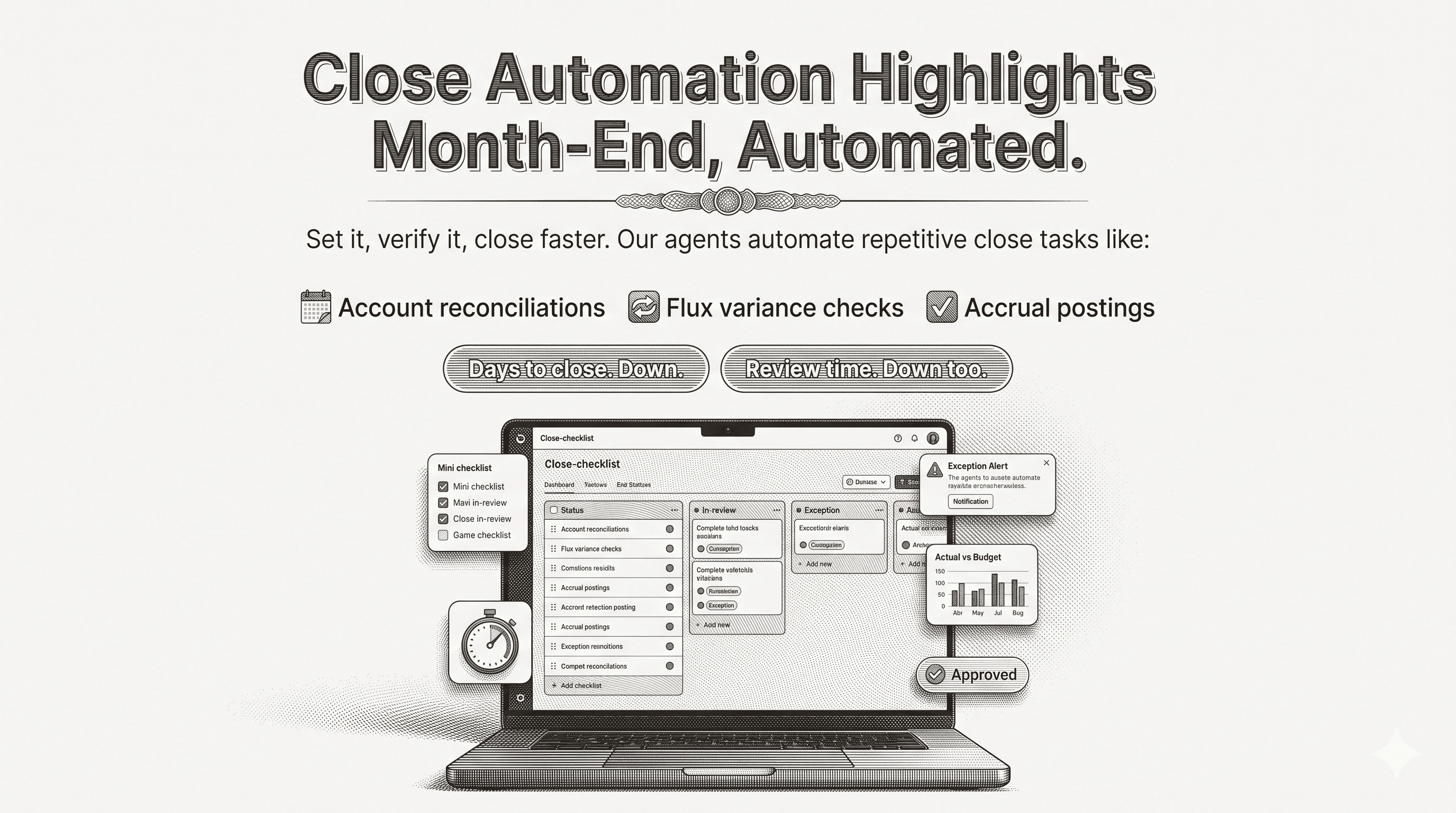
Agents change the access problem. They operate applications the way a person does, through the interface when there is no API, which puts the actual bottleneck inside scope: logging into the bank portals, pulling the statements, extracting the data, building the reconciliation, drafting the accrual entries with support attached, and assembling the flux comparison with first-draft explanations, inside the systems the team already uses. No new platform for the team to learn, no new logins.
The part that matters for a controller who signs the result, since a confident wrong number is worse than a slow right one:
- The work arrives traced. Reconciliations and schedules carry source-linked formulas back to the originating documents and systems, with agent-populated figures marked, so a reviewer verifies by inspection instead of re-derivation. This is the direct answer to the review-loop tax above.
- Validation is structural, not aspirational. Produced work runs through a separate checking pass with audit sampling in a maker-checker loop before a person sees it, and the underlying architecture has models writing reviewable transformation logic rather than freehanding numeric values.
- Your team keeps the judgment layer. Agents do the preparation; exceptions route to people; nothing counts until your reviewer approves it. The close still ends with your sign-off, which is exactly where it should end.
- The data stays where your policies say it stays, including deployment in your own environment for companies whose financial data cannot leave.
Held against the standard this guide set earlier, net hours saved after review and rework, the effect is a phase shift rather than a speed-up: the close window stops being when preparation happens and becomes when review happens. Preparers become reviewers, and the calendar compresses because the critical path items arrive already built.
For the specifics of how this runs on a real close, see Month-End Close and the adjacent Account Reconciliation use case, or book a pilot and put it against your own close calendar, which is the only benchmark that matters.
The condensed close checklist
The one-page version, for the wall. The full template with owner and dependency columns is at The Complete Month-End Close Checklist (planned).
Pre-close (all month)
- Cash activity matched continuously, not saved for month end
- AP queue current; invoice submission deadline communicated
- Suspense and clearing items worked as they appear
- Recurring entries templated and scheduled
Cutoff and subledgers (BD-2 to BD2)
- AP swept, accrual list drafted for received-not-invoiced
- AR billings complete for the period
- Payroll, inventory, fixed asset subledgers closed
- Subledgers locked; late items go to next period or a controlled reopen
Reconciliations (BD1 to BD3)
- All bank, card, and processor accounts reconciled with differences composed and aged
- Every balance sheet account substantiated per its risk rating
- Clearing and suspense at zero or on a dated exception list with owners
Entries (BD2 to BD4)
- Expense accruals posted as reversing entries, support attached
- Prepaids amortized, depreciation posted, payroll accrued
- Revenue recognized per policy; deferred revenue rolled forward and tied out
- Intercompany confirmed, eliminated, FX translated (multi-entity)
Review and lock (BD4 to close)
- Preliminary trial balance reviewed
- Flux explained above threshold, causally, with sources
- Statements derived, not transcribed, from the TB
- Sign-offs recorded, period locked
- Thirty-minute post-mortem: what moves to pre-close next month?