
We Heard From 652 Founders and Finance Leaders. Here's What They Want Fixed in 2027.
23 November 2026
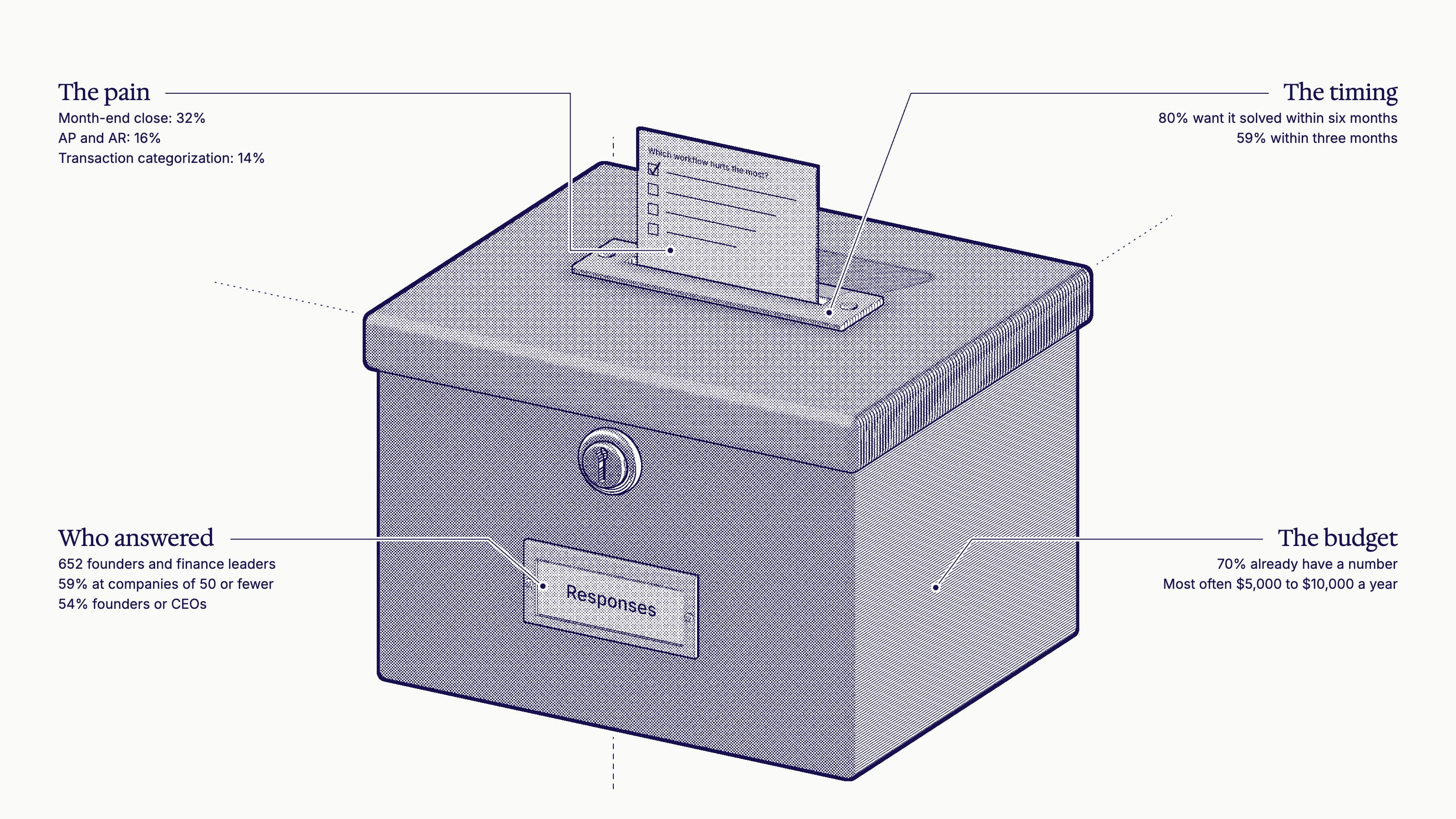
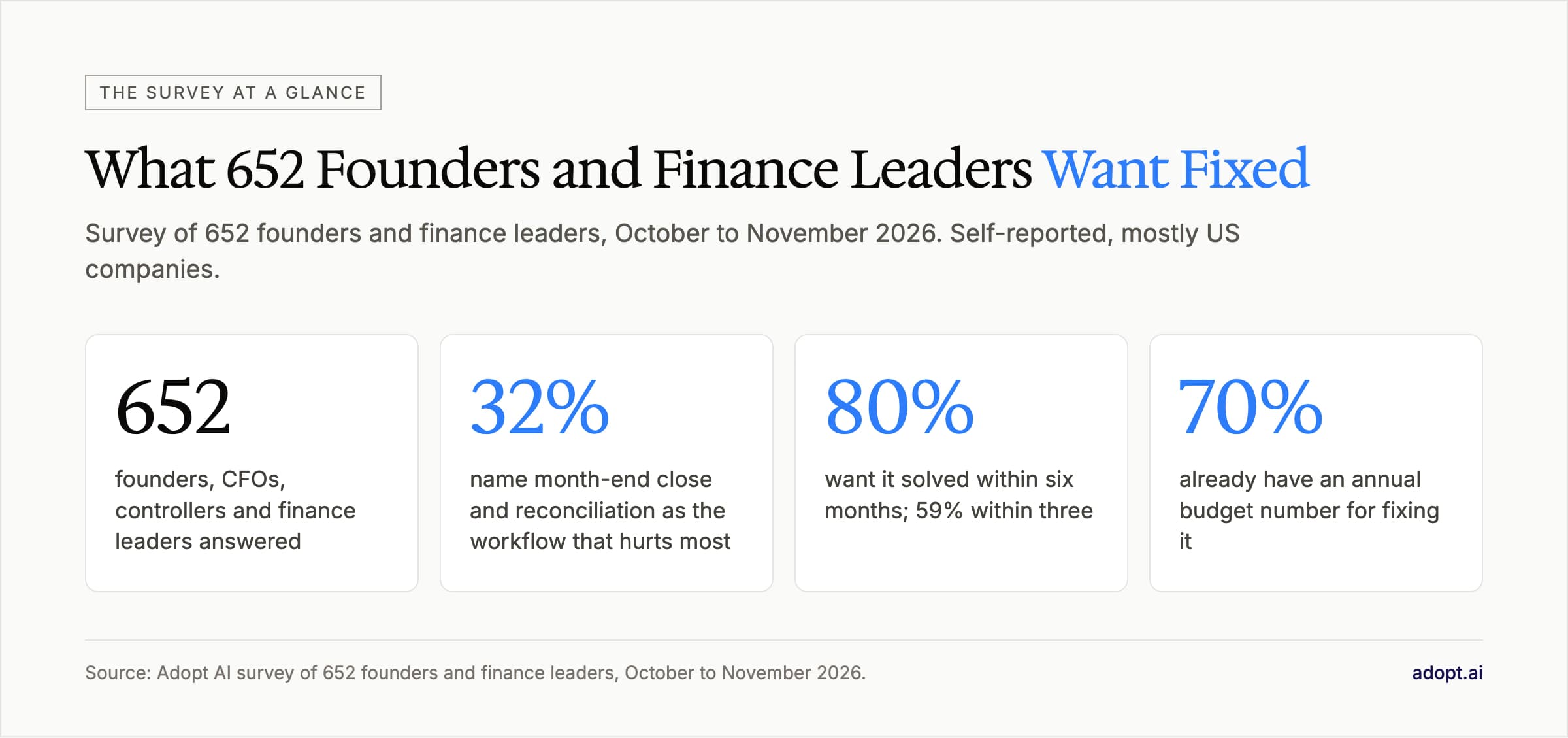
Most "state of finance" reports survey large enterprises. This one went to the people running lean finance teams and the founders who still sign off on the books. In October and November 2026 we heard from 652 founders, CFOs, controllers and finance leaders about their own books.
We asked which workflow hurts most, how soon they want it fixed and what they have budgeted to fix it. Below is every answer, charted, with what we think it means for 2027 planning. Who took part is at the end of the post.
Which workflow hurts the most
We asked one question about pain, with one answer allowed: which workflow hurts the most? Month-end close and reconciliation won by a wide margin, at 32%. AP/AR came second at 16%, then transaction categorization (14%) and bank reconciliation (10%).
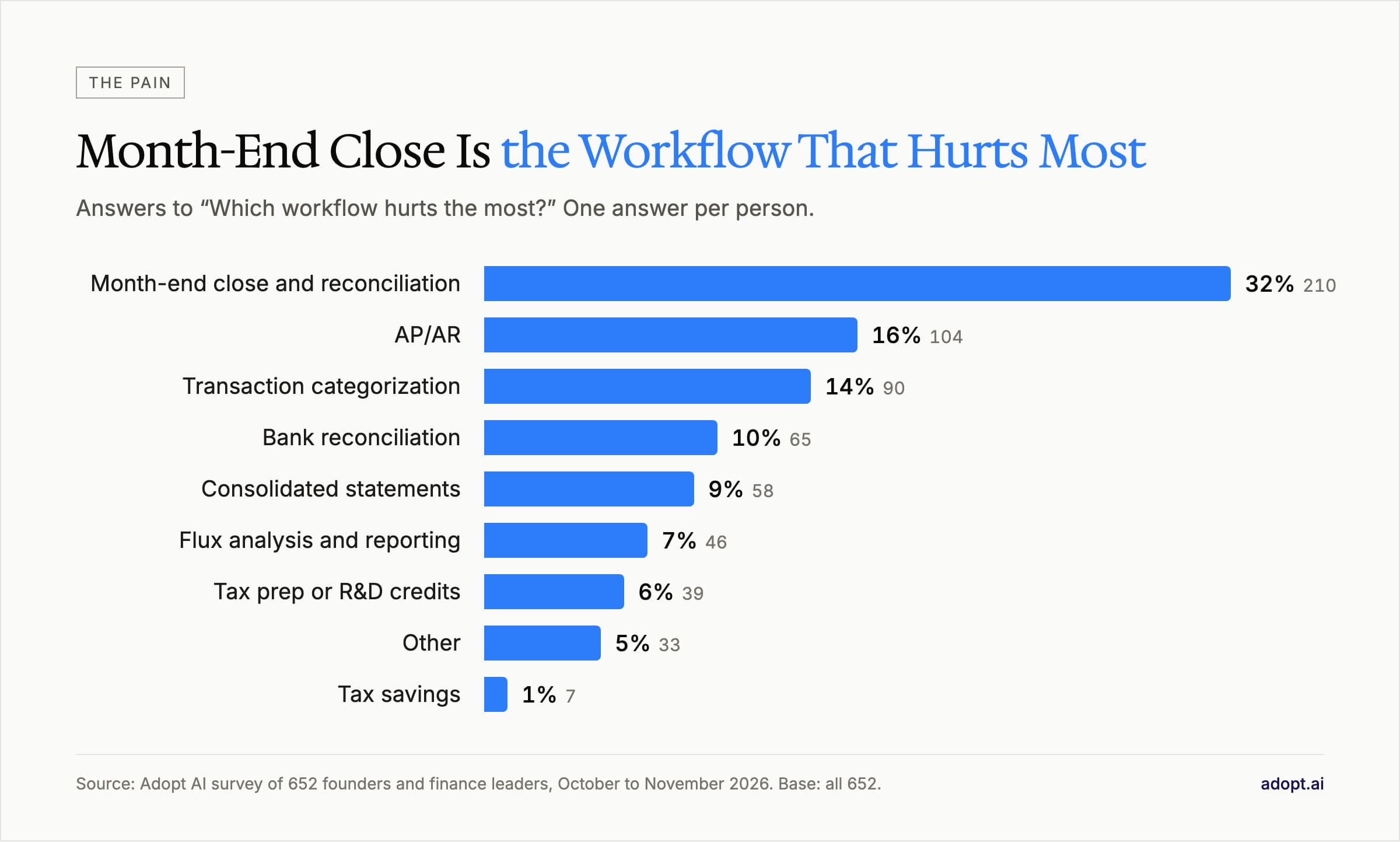
Two things stand out. First, close plus the three daily bookkeeping tasks (categorization, bank recs and AP/AR) account for 72% of all answers. The pain is concentrated in the recurring, transaction-heavy work, not in strategy or analysis. Second, tax came in low. Tax prep, R&D credits and tax savings together drew 7%, even though most respondents were founders, a group often assumed to care most about tax.
The pain moves up the stack as companies grow
When we split the answers by company size, a clear pattern appears. We grouped the workflows into four buckets: bookkeeping basics (categorization, bank reconciliation and tax), month-end close, AP/AR, and reporting (flux analysis and consolidated statements).
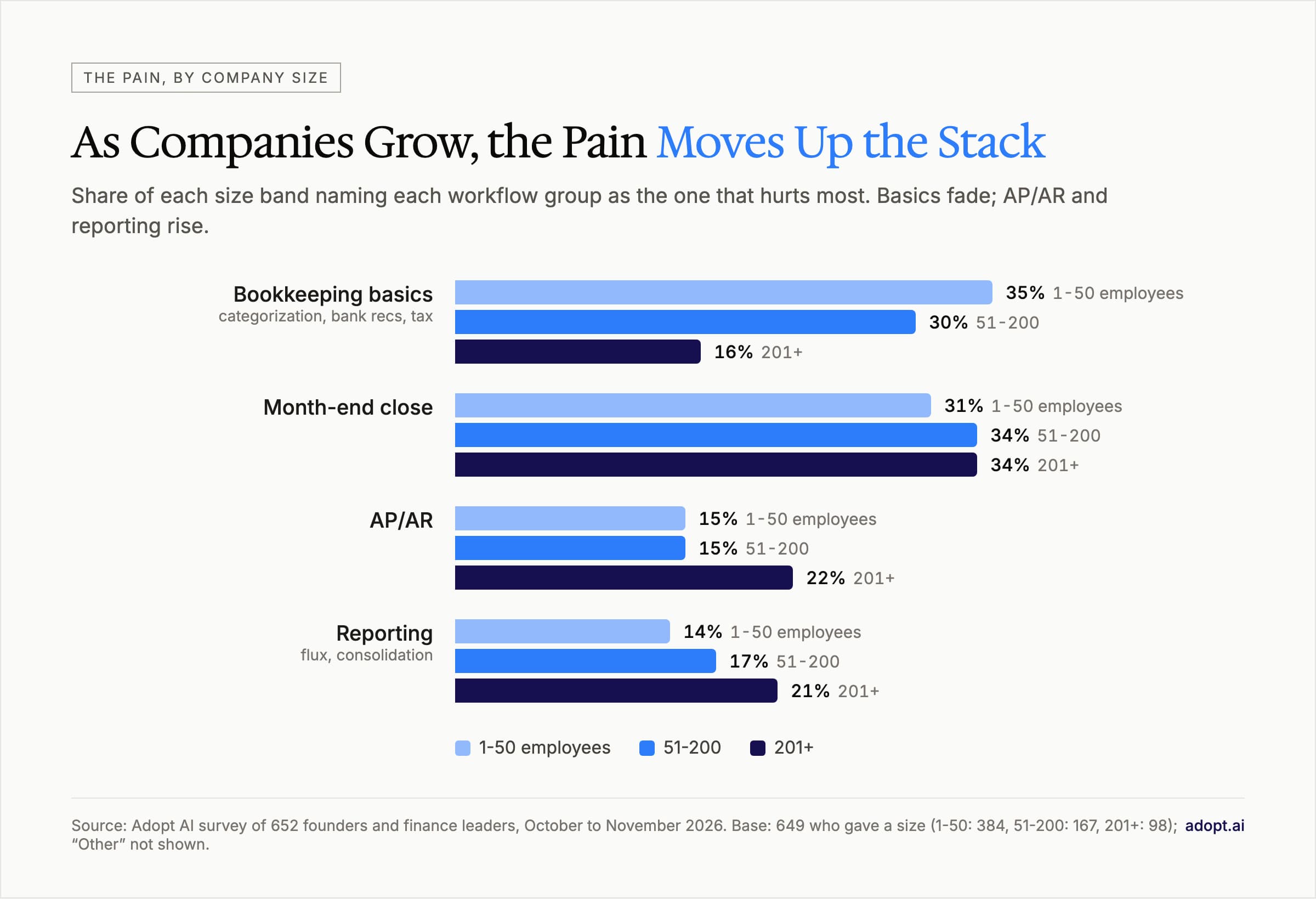
- Basics fade. Thirty-five percent of companies under 50 employees named a bookkeeping basic. Above 200 employees, 16% did. Bank reconciliation alone fell from 11% to 4%.
- The close holds steady. About a third of every size band named the close. It is the one pain that does not go away with scale, it just changes shape.
- AP/AR and reporting rise. Above 200 employees, AP/AR climbs to 22% and reporting to 21%. More vendors, more customers, more entities and a board that wants variance explanations all land here.
The practical reading: a 20-person company's first problem is clean books. A 300-person company has usually solved that with people or software, and its pain has moved to volume (invoices in and out) and to explaining the numbers (flux analysis, consolidation).
Finance leaders feel the close; founders feel the basics
The same split shows up by role. We compared the 133 finance leaders (CFO, VP Finance, controller, head of accounting) with the 344 founders and CEOs.
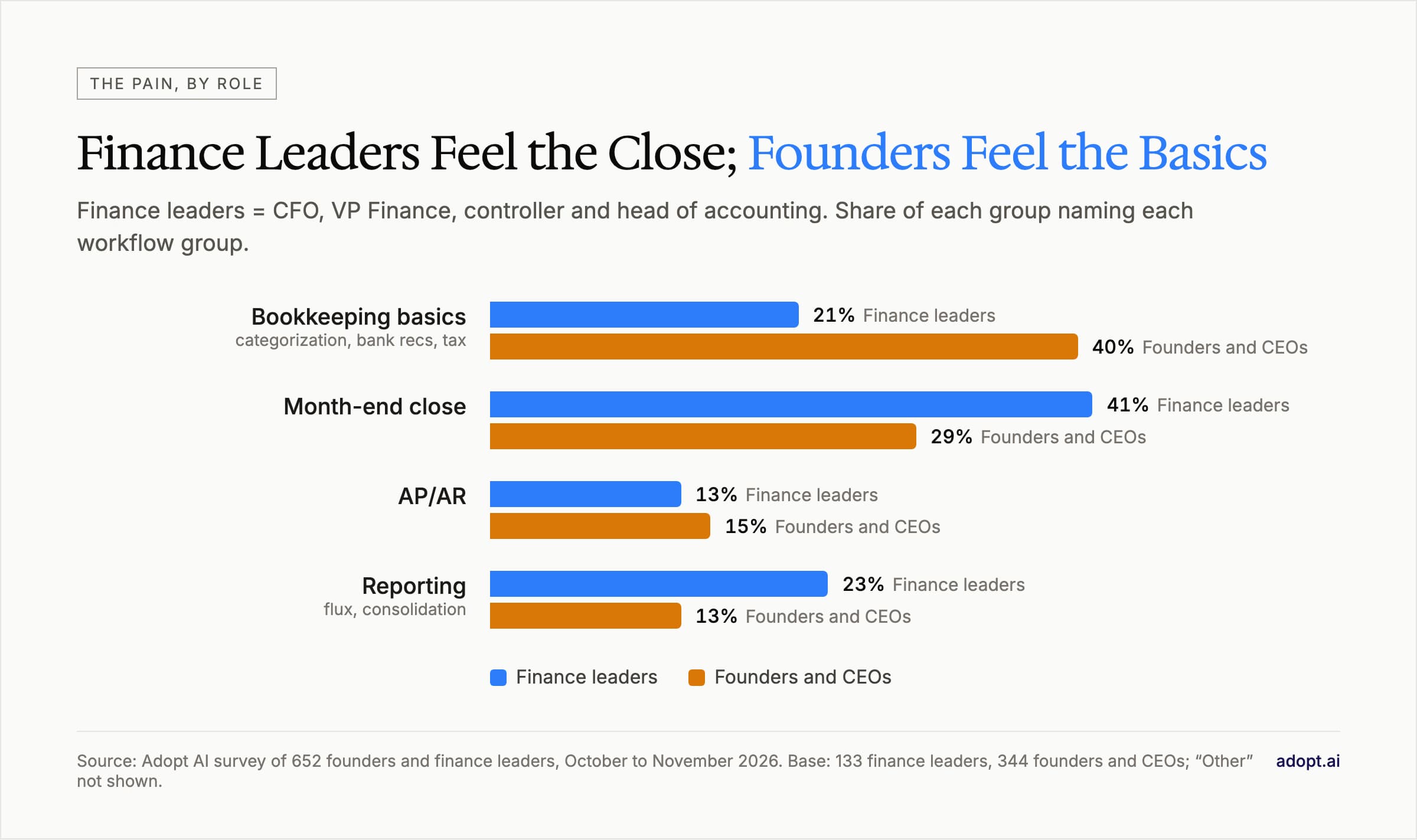
Forty-one percent of finance leaders named the close, against 29% of founders. Finance leaders were also almost twice as likely to name reporting (23% against 13%). Founders, meanwhile, named bookkeeping basics 40% of the time, nearly double the finance leaders' 21%.
This is the closer-to-the-books effect. The person who owns the close calendar sees the late adjustments, the reconciliations that don't tie and the review backlog. The founder sees the symptom one level up: books that are not current, categories that look wrong and cash numbers they can't trust.
How soon they want it solved
Urgency was the most striking result. Fifty-nine percent want their biggest pain solved within three months, and 80% within six. Only 3% said more than six months. Seventeen percent said they were just exploring.
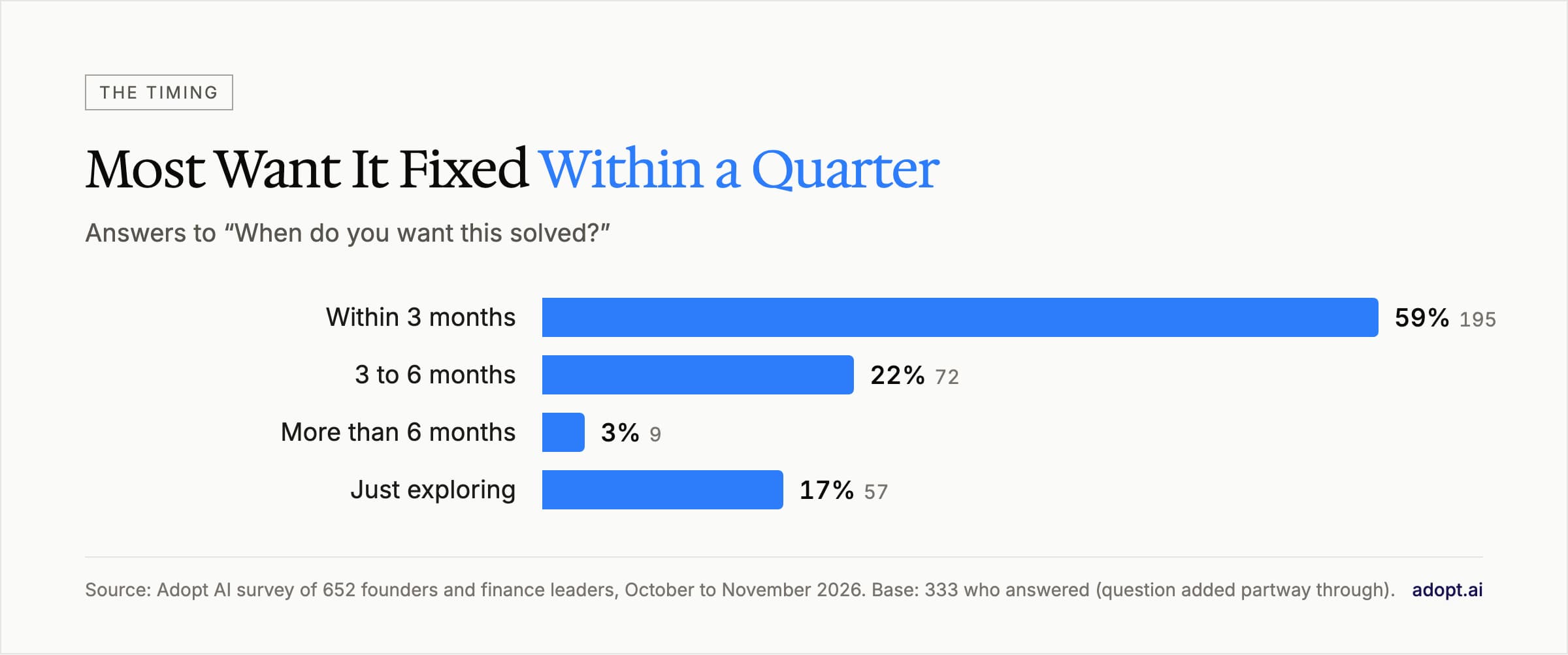
The timing and budget questions were added to the survey partway through, so 333 of the 652 respondents answered them. Every percentage in this section and the next uses that base.
The most common pain is the least urgent
Urgency is not the same for every workflow. Among people whose biggest pain is bank reconciliation, 73% want it fixed within three months. For transaction categorization the figure is 69%. For month-end close it is 47%, the lowest of any workflow.
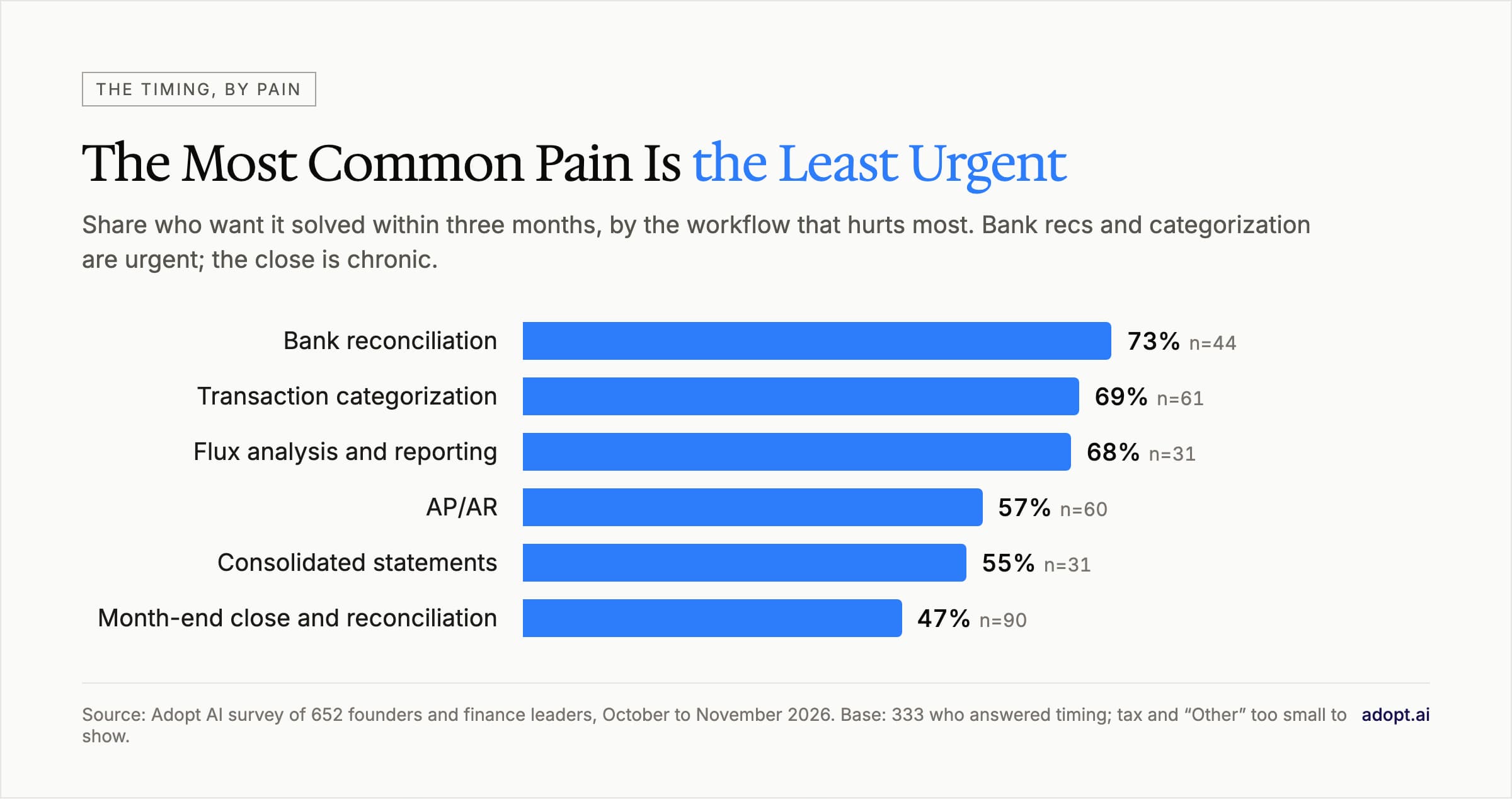
Our reading: daily bookkeeping problems are acute. When bank feeds don't match or a month of transactions sits uncategorized, it blocks everything downstream, so people want it fixed now. The close is chronic. Teams have lived with a slow close for years, built workarounds and learned to absorb it, so it gets named most often but scheduled last. Some of the flux and consolidation groups are small (31 people each), so treat those two bars as directional.
What they have budgeted
Seventy percent of the 333 who answered already had a budget range in mind. The most common answer, by a wide margin, was $5,000 to $10,000 a year (32%). Thirty percent were not sure yet.
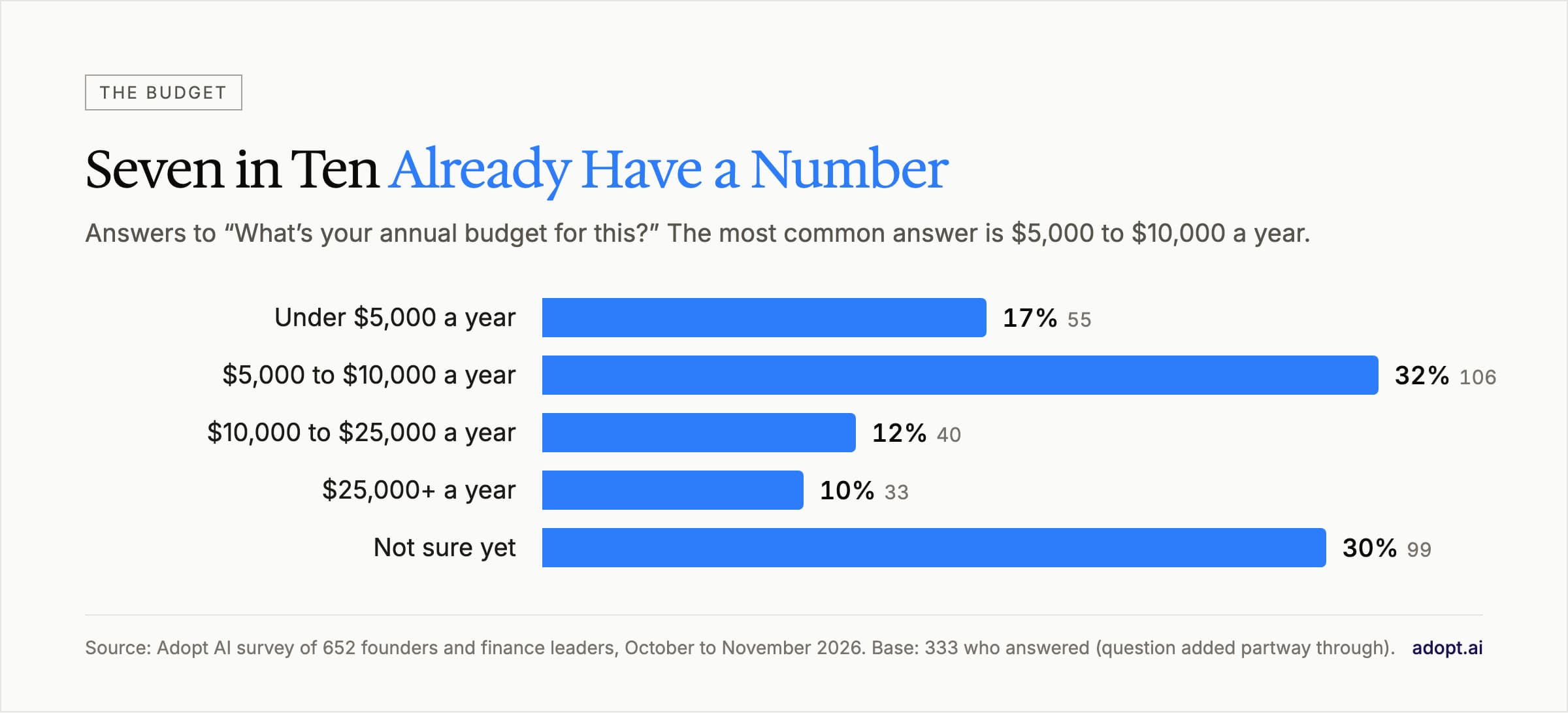
Budget rises with company size, though less steeply than headcount does. Twelve percent of companies under 50 employees budget $10,000 or more a year. That rises to 32% at 51 to 200 employees and 45% above 200.
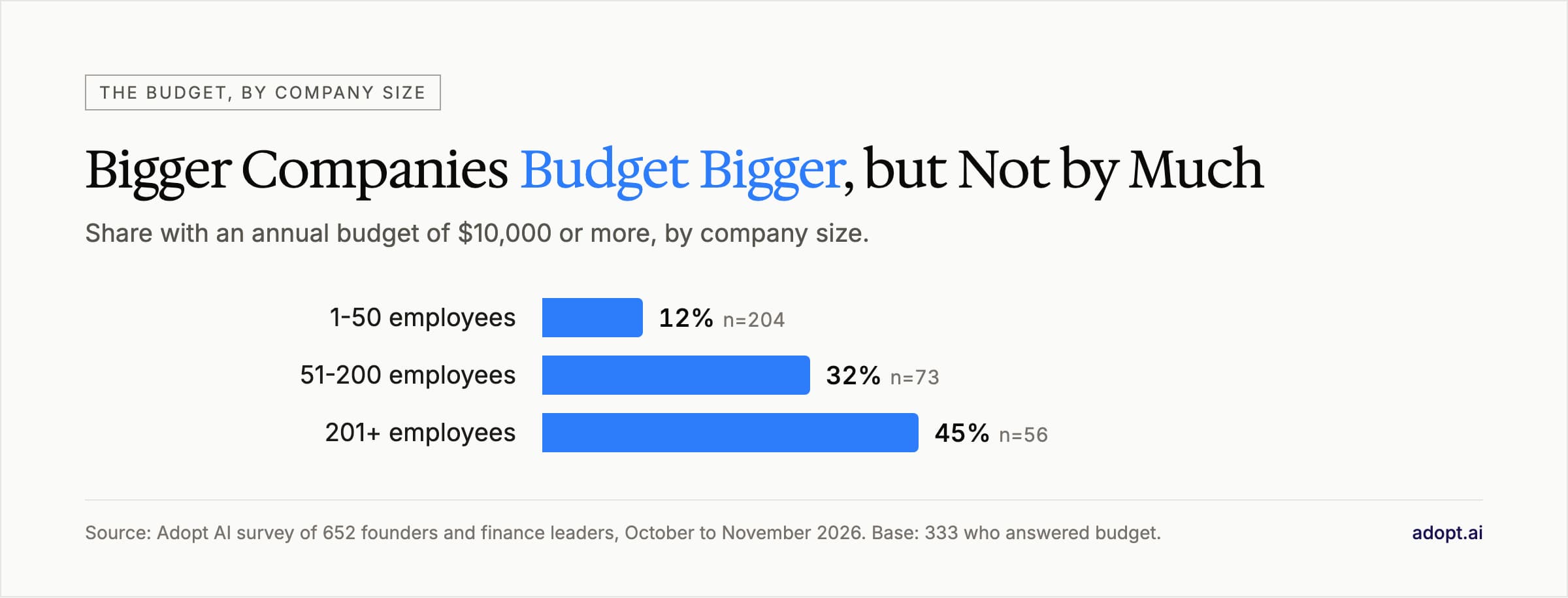
The largest companies were the least sure. Ten of the 22 respondents at companies over 1,000 employees (45%) answered "not sure yet," which fits how budgets work there: the person answering a survey often is not the one who owns the number.
A budget number predicts urgency
The clearest signal in the data is the link between having a number and wanting it done. Among people who named a budget range, 66% want their problem solved within three months and 10% are just exploring. Among those who were not sure of their budget, 41% want it within three months and 34% are just exploring.
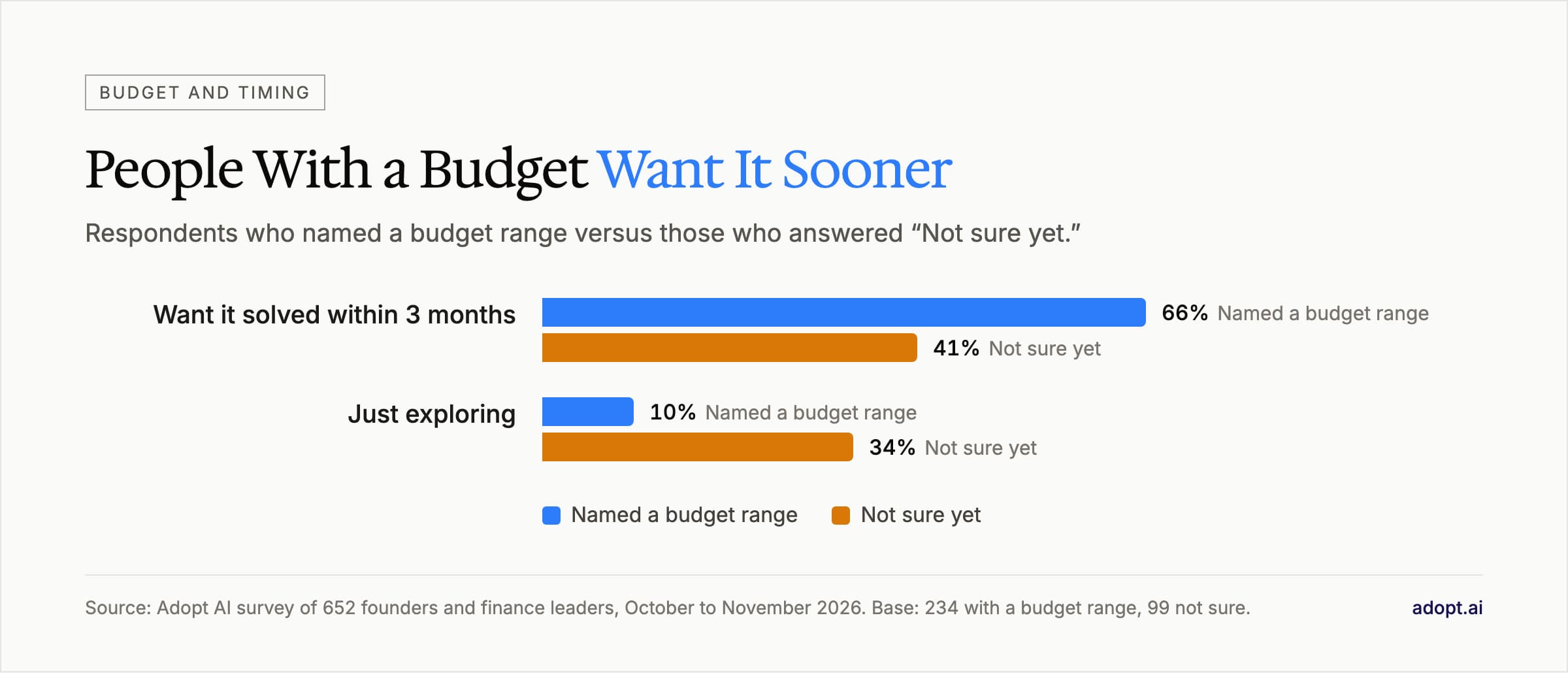
If you are a finance leader trying to get a 2027 project funded, this cuts both ways. Teams that have already put a figure on the problem move faster. Teams that haven't tend to stay in research mode. Putting a number on the pain, even a rough one built from hours spent per close, is the step that turns "we should fix this" into a project.
What this means for 2027 planning
Five takeaways for anyone planning finance work for next year:
- Plan for the close, but fund the basics first if your books are behind. Close is the most common pain, but it rests on categorization and reconciliation. A close cannot be faster than the reconciliations underneath it.
- Expect the pain to move as you grow. If you are crossing 100 or 200 employees in 2027, AP/AR volume and variance reporting are where the next bottleneck is likely to show up.
- Treat a chronic close as a real cost. The close was the least urgent pain in our data, which is how it stays unsolved. Put hours and days-to-close against it so it competes fairly with the fires.
- Put a number on it. People with a budget range were 1.6 times as likely to want the fix this quarter. A rough annual figure is enough to start.
- Ask who feels the pain. Founders and finance leaders described different problems at the same companies. The person approving the spend should hear from the person running the close.
Where Adopt fits
The workflows at the top of this list are the ones Adopt's agents work on. Adopt is AI native accounting and bookkeeping software: agents categorize transactions, match and reconcile bank activity, prepare close work and draft flux explanations, and every number links back to the transaction or document behind it. You approve what posts; nothing reaches your books without a human sign-off.
For a small team, that means clean, current books without adding headcount. For a finance team at a growing company, it means the reconciliations and close prep are ready for review when the period ends, instead of being built by hand in the first week of the month.
Start free on your own books, or book a demo to see the agents on your own close.
About the survey and who took part
The survey ran from October 1 to November 23, 2026. 652 people took part, 98% of them based in the US.
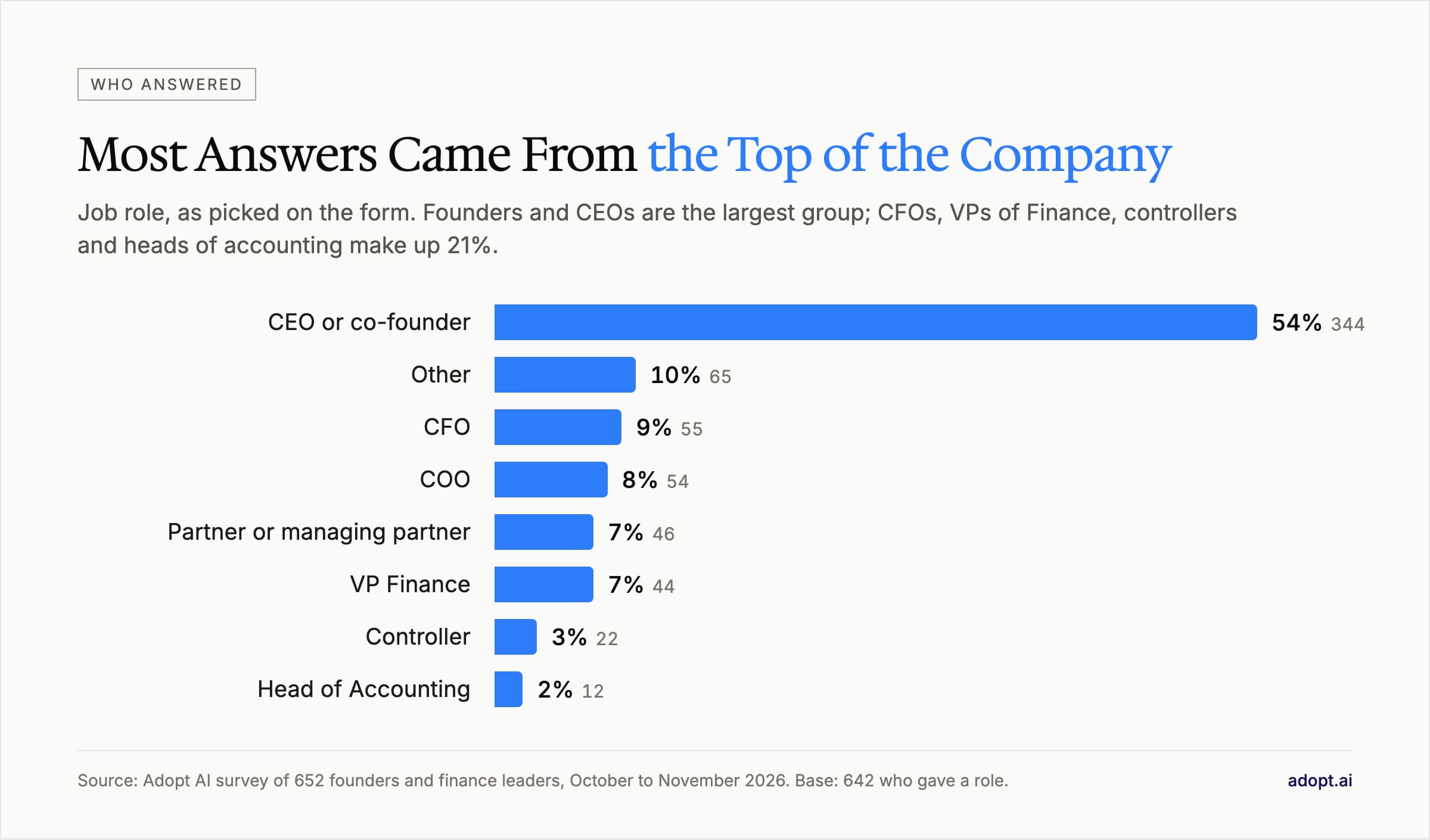
Roles. Most respondents are the person who signs the check. Fifty-four percent are CEOs or co-founders. Another 21% hold a finance title: CFO (9%), VP Finance (7%), controller (3%) or head of accounting (2%). COOs and partners at professional firms make up most of the rest.
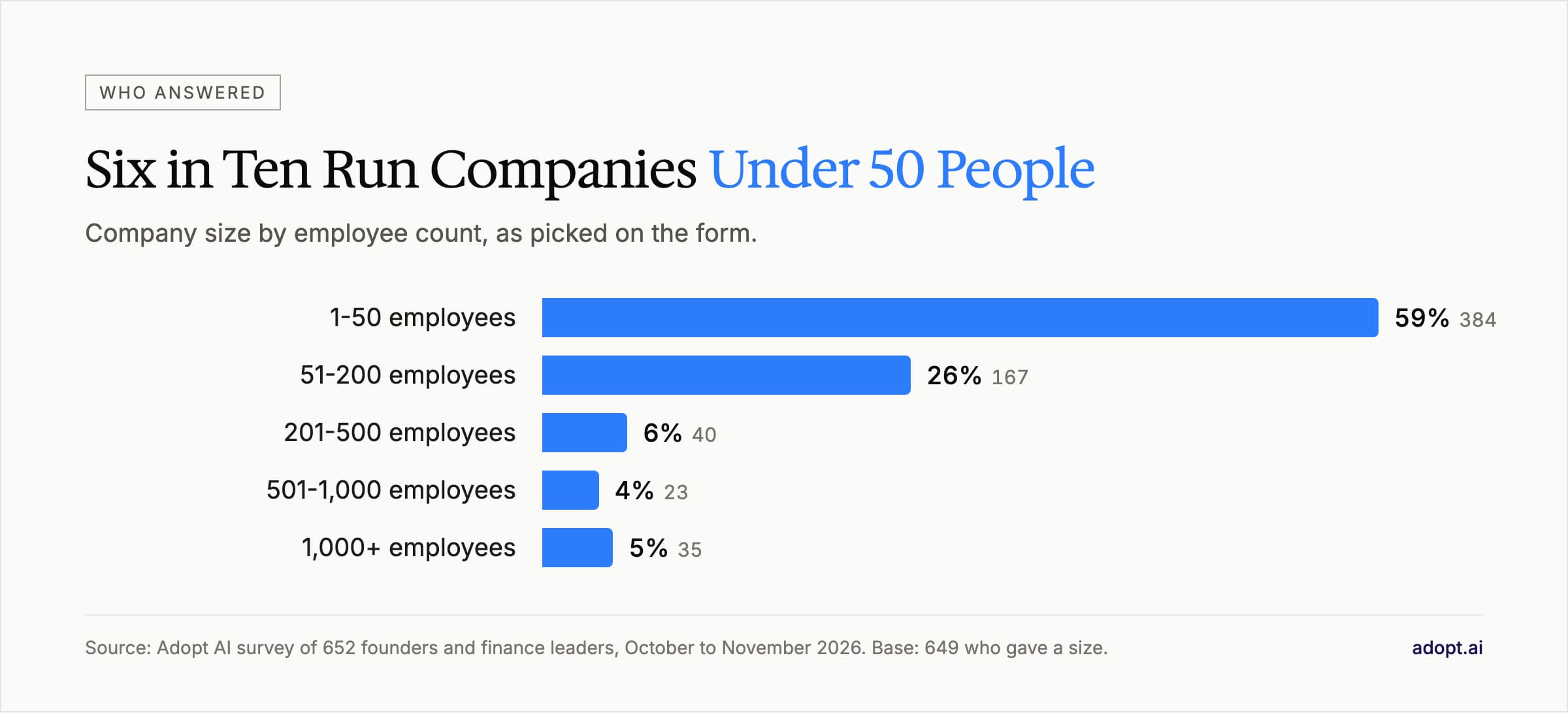
Company size. Fifty-nine percent run or work at companies of 50 or fewer employees, 26% at companies of 51 to 200, and 15% at companies above 200. This is mostly a picture of founder-led and lean finance teams, with a meaningful slice of finance leaders at larger companies.
How we ran it:
- What we asked: role, company size, the workflow that hurts most, when they want it solved and their annual budget for it. Each question allowed one answer from a fixed list.
- Base sizes: all 652 answered the workflow question; 642 gave a role and 649 a company size. The timing and budget questions were added partway through, so 333 answered those.
- Limits: respondents opted in, so this is not a random sample of all companies, and answers are self-reported. Some respondents received a thank-you gift for their time. Percentages are rounded and may not sum to 100.
- Privacy: results are reported in aggregate only. No names, email addresses or company names were used.
We plan to update these numbers as more responses come in. For the wider market picture, see our AI in accounting statistics and the accountant shortage numbers.
FAQs

Related Articles
Why Accounting Automation Stalls (and the Tasks AI Should Not Touch)

Soft Close vs Hard Close: When Each Makes Sense


See it running on your workflows
Automate your accounting workflows