You have an AI mandate from the board or the CEO, a team that already works late in the first week of every month, and three vendor emails this week that all promise the same thing. The mandate is real. The capacity problem is also real. What you lack is a way to tell which AI for finance teams removes work from your people and which one hands them a new tool to babysit.
This guide gives you that way. It covers where AI works in finance today, why most pilots fail and what the failures have in common, a four-question test you can apply to any workflow, how to judge a vendor on the evidence it can show, and a first 30 days plan. It is written for the CFO who has to approve the spend and the controller who has to live with the result.
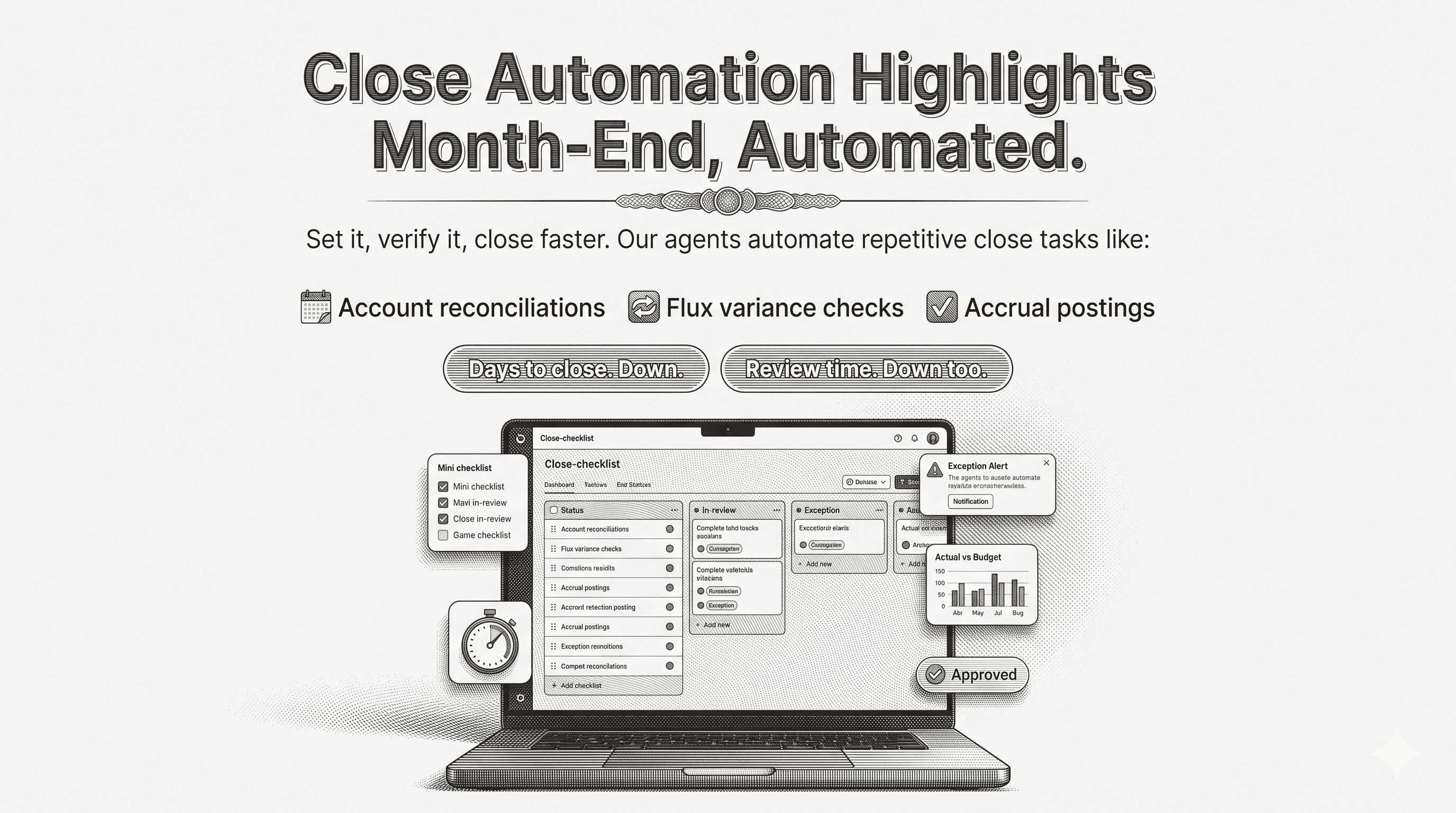
Scope note: this guide is the overview. Each workflow it mentions has its own guide: Account Reconciliation, AP Automation, The Month-End Close, Flux Analysis and Accounting Automation. Read those for the mechanics. Read this one to decide where to start.
The problem AI has to solve in finance
Finance work is gated by a manual execution layer. Skilled people spend their days pulling statements, matching lines, reconciling accounts, chasing approvals and assembling reports. The judgment part of the job, deciding whether a number is right and what to do about it, gets the hours that are left over. And the pool of people willing to do the execution work is shrinking, so hiring more preparers is not an option for many teams.
Teams that time their own work find the same pattern. Close times of six to fourteen days are common, and much of that span goes to assembling the data. A bank reconciliation that takes two hours spends most of them pulling and matching, and the rest deciding what the exceptions mean. An AP clerk whose invoices mostly clear without a problem spends the week on the ones that do not.
That is the target. AI earns its place in a finance team when it takes preparation off the people who prepare and leaves the review with the people who review. Everything else, including the demo that dazzles and the model that scores well on a benchmark, is a distraction from that test.
Where AI works in finance today
AI works in finance when the task has four properties: the inputs are structured or can be structured, the correct answer can be checked against a source, the volume is high enough to matter, and a person can review the output faster than they could produce it. Five workflows meet those properties in most finance teams.
| Workflow | What the AI does | What stays with a person | Where it breaks |
|---|---|---|---|
| Bank and account reconciliation | Pulls the statement and the ledger, matches lines, proposes entries for reconciling items | Approving entries, deciding on items that fit no pattern | Statements that live behind a bank portal with no API; unclear ownership of old reconciling items |
| Transaction categorization | Suggests a category with a confidence score for each bank line | Accepting or correcting low-confidence suggestions | Treating every suggestion as final; no abstention rule for ambiguous lines |
| AP intake and coding | Reads invoices, extracts fields, checks for duplicates, proposes GL coding, runs the PO match | Approving payment, resolving mismatches that need a vendor conversation | Invoices with no PO; vendor master data that nobody maintains |
| Flux and variance commentary | Computes period movement, applies thresholds, drafts a sourced explanation for each flagged line | Judging the drivers it cannot source, signing off | Explanations that restate the number instead of citing evidence |
| AR follow-up and cash application | Matches payments to open invoices, drafts collection notes, flags disputes | Collection decisions on key customers, write-offs | Remittance detail that arrives in a portal or a PDF |
Notice what the table leaves out: payment execution, the final sign-off on the numbers, and any judgment about a transaction the evidence cannot explain. Those stay with people in every deployment worth trusting. The pattern in the work AI does handle is consistent: preparation moves to the software, and a named person reviews and approves.
What the review step looks like
A reconciliation agent that proposes 400 matches does not ask the reviewer to confirm 400 matches. It groups them by the rule that produced them, shows the exceptions it would not match, and states why. The reviewer samples the rule-based matches, works the exceptions, and approves. Review time depends on the exception count, not the transaction count. That shift, from confirming everything to working the exceptions, is where the capacity comes from.
Why AI pilots fail in finance
Most finance AI failures follow one of six patterns. Each one is recognizable before the pilot starts, which means each one is avoidable.
1. The chain is too long for the accuracy. A step that is 95 percent accurate sounds good. Ten of them in a row complete without error about 60 percent of the time, because 0.95 raised to the tenth power is 0.60. General-purpose AI tools handle a single drafting step well and fail on a twelve-step workflow that pulls a statement, matches it, posts an entry and routes an approval. Reliable finance automation breaks the chain into steps, checks each one, and stops at a gate when a check fails.
2. The model does the math. A language model that reads two numbers and tells you the difference will sometimes tell you the wrong difference. Arithmetic belongs in deterministic code that a person can read. The model's job is to write the format conversion, draft the explanation or classify the item. Ask any vendor where the arithmetic runs.
3. The agent guesses instead of flagging. An unexplained variance filled in with a plausible reason is worse than a blank, because the reviewer now has to find out the reason is wrong. A system worth deploying leaves the item open and says it could not find support. See what the 97 percent model teaches about abstention for a worked evaluation.
4. Nobody owns the output. When the AI drafts and no named person reviews, the controller inherits the risk without the control. The preparer and the reviewer should be named on every row.
5. The pilot has no workflow, owner or date. A free month without a named workflow, a named owner and a date for the data produces a login and nothing else.
6. The data has to be perfect first. Teams postpone a pilot for a data cleanup that never finishes. Agents do not need a warehouse. Start with one flow on the data you have while the cleanup runs in parallel.
The failure that sits under all six is a mismatch between what the tool does and what the buyer assumed. For a longer look at the gap between AI spend and AI return in finance, see The Finance AI Adoption ROI Gap.
A four-question test for any workflow
Before you spend a pilot on a workflow, run it through four questions. A workflow that gets four yeses is a good first candidate. A workflow that gets two or fewer should wait.
1. Is the correct answer checkable against a source? A bank reconciliation ties to a statement. A flux explanation ties to a contract or a subledger entry. A forecast does not tie to anything yet. Start where a reviewer can verify the output without redoing the work.
2. Is the volume high enough that a saved minute adds up? A task you do twice a month is not worth an agent. A task you do two hundred times a month is. Count how many times the task occurs and how long each one takes today. Use your own numbers.
3. Does the exception rate leave room for a human to be useful? If 99 percent of items match, the exceptions are few and the reviewer's time is well spent. If 40 percent are exceptions, the process has a data problem that automation will expose rather than fix.
4. Can the system reach the data without a migration? If the evidence lives in an ERP, a bank portal and a shared drive, the agent has to operate those. A tool that needs you to replace the ERP or export everything to a new system first adds a project before it saves an hour.
Run the test with the controller in the room. The controller knows which reconciliations eat the week, which accounts have recurring exceptions and which workpapers the auditors sample. The CFO sets the priority. The controller supplies the truth about the work.
How to judge a vendor on evidence
Every vendor in this category says some version of "AI agents for finance." Four questions separate the ones with a mechanism from the ones with a demo.
Where does the arithmetic run? The right answer is deterministic code. A vendor who says the model computes the totals has a reliability problem at scale.
What happens to an item the system cannot explain? The right answer is that it stays visible and unexplained, routed to a person with the reason. A vendor whose demo never shows a failure has not shown you the part that matters.
Who approves, and where is that recorded? Look for a named preparer and a named reviewer on every row, with an audit trail that a SOX compliance reviewer or an external auditor can follow. Nothing should post to your books without a human sign-off.
What do the percentages mean? Be skeptical of a bare accuracy or automation figure. Ask for the denominator: touchless out of which population of invoices, matched out of which kind of statement. A claim of 90 percent on clean PO invoices says little about a team where half the invoices have no PO.
Add three practical checks for finance leaders:
- Data location. Cloud, your own VPC, or on-prem, and which models, with which retention terms. Zero data retention with the model providers and no training on your data are the baseline. AI accounting data privacy covers what to ask.
- Ownership. Can you take the workflows and go? Skills and agent definitions that export in an open format turn vendor risk into a manageable question.
- Proof on your data. A test on a month you have already closed lets you compare the output to answers you know are right, before you commit to anything.
What the team's role becomes
The question the team will ask before the CFO finishes the announcement is whether the AI replaces them. Answer it directly and early. The answer that holds up is that the work changes shape: preparers become reviewers, reviewers become operators of the agents, and the strongest operators become the people who build the next workflow. Finance engineers is the label some teams use for that last group.
This is a staffing claim as much as a technology claim, so it needs a plan. Name who reviews. Name who owns each agent. Give your senior accountants a reason to want the change: the review queue replaces the grind, and the person who understands the reconciliation gets to teach the agent how it is done. For the data behind the replacement question, see Will AI Replace Accountants? and the job description in The AI Controller.
Told in the wrong order, the team hears that they are being automated first. Lead with the capacity problem the team already feels, then the role, then ownership. A team that cannot hire its way out of a backlog does not need to be convinced the backlog exists.
How AI agents differ from the tools you already have
Three kinds of tool compete for the same budget, and each solves a different part of the problem.
General-purpose AI tools such as the ones already licensed in your productivity suite help one person draft one step. They cannot pull the statement, post to the ERP or hold a review gate. They are useful for the controller who wants to draft a memo. They do not run a reconciliation.
Close and workflow platforms track the work. They tell you whether the reconciliation happened and who signed it. A person still does the reconciliation. Many now add AI features on top, so ask what is drafted and what is only tracked.
AI agents for finance workflows do the preparation inside the systems you already use: they pull the data, match, draft the entry, explain the variance and stop at the approval gate. Adopt is in this group. Full disclosure: Adopt builds this kind of agent, so read the comparison as the view of an interested party. The test is the same as for any vendor on this page: ask for the mechanism and the evidence.
For how the pieces fit into one stack, see The Finance Team Tech Stack.
Where Adopt fits
Adopt is AI native accounting and bookkeeping software. Agents do the categorizing, reconciling and closing, and your team approves what ships. On the enterprise side, Adopt works on the ERP your finance team already runs, so there is no rip and replace and no migration. Your team's workflows are built with your people, and you own them.
Four design choices matter to the reader of this guide:
- Preparer and reviewer on every row. The agent prepares. A named person reviews. Nothing posts to your books without that sign-off, and Adopt does not move money.
- The model does not touch the numbers. The arithmetic runs in deterministic code that people review. Models write the format conversions and the explanations.
- Systems without usable APIs are in scope. Agents work with interfaces and portals the way a person does, which covers the bank portals and legacy systems that most automation skips.
- You choose where it runs. Adopt cloud, your own VPC or on-prem, with your choice of model and your own keys.
To see how this looks on a specific workflow, read the use cases for Account Reconciliation, Month-End Close and Accounts Payable Automation.
Your first 30 days
A first pilot needs one workflow, one owner, one data date and one definition of success. Here is a sequence that fits in a month.
| Week | What happens | Output |
|---|---|---|
| 1. Choose | Run the four-question test on three candidate workflows with the controller. Pick one. Name the owner and the reviewer. | One workflow, two names |
| 2. Baseline | Time the workflow on a closed month: hours by step, exception count, who reviewed. Collect the files or system access the agent needs. | A baseline in your own units |
| 3. Run | Run the agent on the closed month and compare its output to the answers you already have. Log every exception and every miss. | A side-by-side result |
| 4. Decide | Review the misses with the owner. Decide whether to run it on the live close with a review gate, extend the scope or stop. | A go, extend or stop decision |
Write down the success measure before week 1 ends. Good measures are hours of preparation moved to review, exceptions sent to a person with a reason, and items the system declined to explain rather than guessed. Bad measures are an accuracy percentage with no denominator and a headcount figure.
If the pilot works, move to a live close with the review gate in place, then add the next workflow. If it does not, the week 3 comparison will tell you whether the cause was the data, the workflow choice or the tool, and you will have spent a month instead of a quarter finding out.
What to avoid in the first 30 days
- Do not start with the hardest workflow. Pick one with a clear source of truth and enough volume to matter.
- Do not skip the baseline. Without it, every claim of time saved is an estimate you cannot defend to the board.
- Do not let the pilot run without a named reviewer. The reviewer is the control.
- Do not wait for clean data. Start with one flow while cleanup continues.
The condensed checklist
Before you pick a tool
- One workflow chosen with the four-question test
- A named owner and a named reviewer
- A baseline timed on a closed month, in your own units
- A success measure written down before the pilot starts
When you evaluate a vendor
- The vendor states where the arithmetic runs
- The demo shows an item the system could not explain
- Preparer, reviewer and audit trail are visible on every row
- Every percentage comes with a denominator
- Data location, model terms and ownership are in writing
When the pilot runs
- Output compared to a month you already closed
- Every exception and every miss logged
- Nothing posts without sign-off
- A go, extend or stop decision made on the evidence
This guide describes AI for finance teams as it applies to in-house finance functions. Workflows, controls and approval structures differ by company, and the four-question test and the evidence checklist are the constants.