COMPARISON
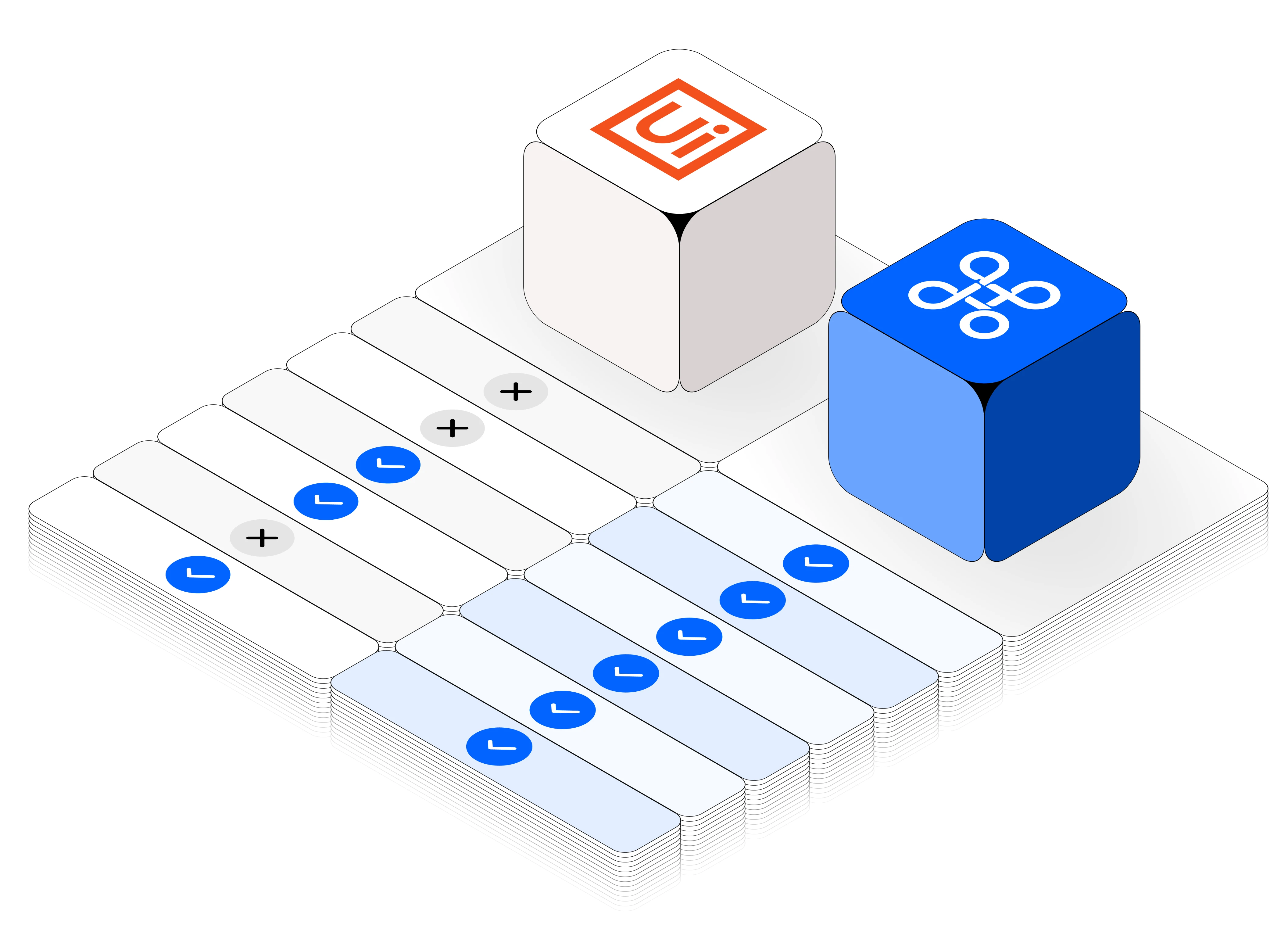
UiPath defined the modern RPA category, enabling enterprises to automate repetitive UI-driven tasks at scale.
Adopt AI represents a different architectural model: governed, goal-driven agents that coordinate across UI, APIs, and browser layers to complete outcomes, not just steps.
Trusted by the best






Synthesized from community discussions and documented platform capabilities


Mature attended and unattended bot automation for legacy and desktop environments.
Established RPA governance models and centers of excellence.
Structured task automation with defined workflows.
Extensive RPA ecosystem and marketplace.

Bot maintenance increases as UI changes or workflows become less deterministic.
Task-oriented automation that follows predefined scripts rather than dynamic goals.
Limited cross-system reasoning without additional tooling. to measure outcomes
Scaling complex logic may require deeper technical expertise.
Not a replacement for APIs, but an expansion of what can be executed.
RPA tools automate predefined UI steps and structured task sequences. They execute exactly what is recorded or configured.
Optimized for deterministic, repeatable processes.
Depend on stable UI layouts and predefined paths.
Exception handling must be explicitly modeled in advance.
Scaling complexity often increases maintenance overhead.
.webp)
Agents plan, execute, verify, and adapt across UI, APIs, and browser surfaces. Instead of following fixed scripts, they reason about goals and determine the next best action dynamically.

Designed for multi-step, cross-system coordination.
Incorporate verification and recovery loops.
Adapt to variable inputs and changing system states.
Shift automation from task completion to outcome delivery.
DISCOVERY
Discovers API behavior from live applications through browser-based exploration, producing a usable catalog of actions.
ACTIONS
Transforms discovered behaviors into validated, reusable actions with inputs, outputs, and guardrails.

EXECUTION
Builds goal-driven agents using natural language or configuration, then deploys with governance and observability.



Focus chart shows emphasis, not quantified metrics.

You're prioritizing structured UI automation at scale and

Repetitive, deterministic UI workflows dominate operations.
Primary need is desktop or legacy task automation.
Automation teams are structured around RPA programs.

Best aligned with teams seeking governed agents capable of cross-system execution beyond API-only environments and
.svg)
Want outcome driven execution with IT governance, oversight, verification and recovery.
Looking to have agents built into your product, or made available through MCP and other platforms.