

Discover how logistics teams use AI agents to automate rate management, invoice disputes, and carrier portals in 2026 cutting costs and manual workloa


TL;DR
- Traditional logistics software fails because it records data instead of acting on it. AI agents close this gap by navigating unstable carrier portals and fragmented emails that break standard RPA and iPaaS tools.
- By moving beyond brittle scripts, agents use goal-oriented logic to authenticate, scrape, and normalize rates across 15+ portals simultaneously, slashing quote times from 20 minutes to under 2.
- New carrier onboarding now takes 24 hours rather than weeks of developer sprints. Agents automatically discover system behaviors and adapt to UI changes without needing pre-built connectors or manual documentation.
- Automation shifts from simple data entry to operational decision-making by cross-referencing invoices against complex contract terms. This allows for 100% audit coverage, recovering millions in overcharges that manual sampling misses.
- Reliable deployment relies on confidence thresholds, not total autonomy. High-risk exceptions or anomalous pricing are routed to experts with a full evidence chain, ensuring commercial accuracy without sacrificing speed.
- Modern agent layers plug into legacy systems like CargoWise or SAP TM without requiring a "rip and replace" strategy. This allows firms to maintain their existing tech stack while extending its capabilities through agentic execution.
Why Freight Operations Still Run on Manual Workflows Despite Years of "Digital Transformation"
The freight forwarding market was valued at USD 216.47 billion in 2024 and is projected to reach USD 285.60 billion by 2030 according to Grand View Research. A market at that scale, still moving billions of containers annually, largely runs its day-to-day quoting and invoicing operations through a mix of browser tabs, forwarded emails, and copy-pasting between screens.
The gap isn't a knowledge problem; logistics teams understand they need automation. The problem is structural: the tools they've adopted (Transportation Management Systems, ERPs, and iPaaS connectors) were built to record what happened, not to act across the fragmented environments where freight data actually lives. Getting a single shipping quote requires a rep to log into 15-20 carrier portals, extract rate data from PDFs and plain-text emails, reconcile floating surcharge clauses, and compile everything into a response. According to Adopt AI's freight rate management use case, a single request takes 20-30 minutes, and complex multi-route queries can stretch to 2-3 hours. McKinsey's research shows that embedding AI in distribution operations can reduce logistics costs by 5-20%. The operations that close that gap fastest are the ones attacking the manual workflow layer directly, not adding more dashboards on top of it.
In this article, we'll cover why legacy automation tools haven't solved the core integration problem, how agent-based freight automation works at the system level, what the rate management and invoice dispute workflows look like end-to-end, deployment architecture decisions for freight platforms, and what metrics actually indicate a successful automation deployment.
The Three Integration Gaps That Keep Manual Work Alive
Traditional iPaaS platforms and RPA tools hit three walls in freight environments that they've never convincingly solved.

The first wall is carrier portal instability. Carrier portals change their UI layouts, session token logic, and rate display formats without notice or API versioning. An RPA script built against Maersk's portal in January may break silently by March. There's no error alert. There's no fallback. A rep discovers the gap only when a quote comes back wrong or empty. Brittle flows tied to UI elements are exactly why, as Adopt AI's own product positioning notes, legacy automation "breaks silently, [and is] hard to recover."
The second wall is data format heterogeneity. Carriers don't transmit rates in a standard schema. PDFs arrive with surcharge footnotes buried in page 4. Excel sheets use non-standard port code abbreviations. Plain-text emails contain floating clauses like "subject to change at carrier's discretion" that can cost thousands of dollars on a high-volume lane if a rep doesn't catch them before quoting a customer. OCR alone doesn't solve this: extracting the right six fields (origin, destination, container type, rate, validity period, and surcharge structure) requires domain-specific understanding of freight terminology, incoterms, and demurrage definitions.
The third wall is ERP and TMS architecture. CargoWise, SAP TM, and Oracle Transportation Management weren't built to be targets for autonomous agent execution. They have APIs in some areas and not others, they have legacy interfaces that expect human input, and they don't expose internal state in a way that makes agentic workflows easy to attach. Any automation layer has to work around these systems' constraints without requiring a full replacement.
Why Headcount Scaling Fails as a Fix
Hiring more reps to handle volume growth sounds straightforward until you account for the time it takes to make them useful. Training new hires on carrier portal quirks, port code conventions, incoterm structures, and surcharge interpretation takes months. During that ramp period, throughput doesn't increase proportionally. Freight volume, meanwhile, doesn't wait for training programs to finish.
Adopt AI's freight rate use case notes explicitly that when agents handle lookup and aggregation, new hires become productive within days rather than months, because the cognitive load of remembering 15 portal login procedures and memorizing surcharge clause variations is shifted to the automation layer. Headcount still matters for exceptions, escalations, and relationship management. It doesn't scale well as the primary mechanism for rate fetching.
What AI Agent-Based Freight Automation Means at the System Level
The term "AI automation" gets applied loosely across everything from scheduled Excel exports to fully agentic workflows. For freight operations leads and platform engineers evaluating tooling, the architecture distinctions matter practically, because the failure modes are different and the integration surface area is significantly wider with agent-based systems than with traditional connectors.
The core difference is execution logic; traditional RPA follows a fixed script. iPaaS connectors transfer data between two systems when triggered. AI agents receive a goal, reason about the steps required to reach it, execute across multiple systems, verify the outcome, and recover when something changes. A freight agent tasked with fetching a rate doesn't just trigger a connector. It authenticates against a portal, navigates the rate request interface, extracts the result, normalizes the format against other carriers' outputs, and flags anomalies before returning a structured output.
Zero-Shot API Discovery Versus Pre-Built Connectors

Adopt AI's Zero-Shot API Discovery, referred to as ZAPI, is the capability that makes carrier onboarding operationally viable at scale. Traditional connector platforms require engineers to model a target system before agents can act against it: documentation, schema mapping, field matching, and a developer sprint to build and test the connector. When the target system changes, the process repeats.
ZAPI removes the documentation dependency. Agents automatically discover APIs and system behavior without pre-built connectors, and Adopt AI states that new carrier portals can be onboarded in 24 hours. For a freight forwarder covering Maersk, Greenex, and 15+ additional carriers, the difference between 24-hour onboarding and a two-week developer sprint per carrier determines whether automation covers the full carrier mix or only the two or three with clean APIs.

The agent will simulate the workflows you’ve defined—clicking, navigating, triggering actions, just like a real user would. It captures every backend API triggered along the way.

The practical implication: when a carrier updates its portal's authentication flow or changes how it presents rate tables, a ZAPI-enabled agent adapts. A connector-based system requires a developer to notice the breakage, triage it, and push a fix. During that gap, the rate data for that carrier is simply missing from quotes.
How Agents Handle Authentication, Rate Limits, and Bot Detection
Carrier portal automation is technically harder than standard API integration in ways that don't get discussed enough. Production freight agents operate across 15+ portals simultaneously, each with its own session management logic. They must handle authentication token renewal, respect cool-off periods between requests on the same portal, and avoid triggering bot detection systems that would cause IP bans and rate data blackouts.
Adopt AI's approach, as described in its freight rate use case, uses human-based crawling that explicitly respects rate limits across each carrier. Getting this wrong doesn't produce a visible error message. It produces a silent data gap: the agent appears to have run, but the carrier's rate is missing from the aggregation. On high-volume lanes, missing one carrier's rate means quoting customers against an incomplete picture and potentially losing bids to competitors who have that carrier's pricing.
The session management layer is where most self-built automation approaches break. Handling 15 simultaneous portal sessions across carriers with different authentication requirements, session timeouts, and rate-limit policies is a systems engineering problem, not just a scripting one.
Structured Action Generation from Unstructured Carrier Data
The extraction pipeline for inbound carrier emails involves more than reading a document and pulling numbers. An agent processing a carrier rate email must identify six mandatory fields: origin port, destination port, container type (20ft, 40ft, 40HC), base rate, validity period, and the full surcharge structure. That last field is where most failures happen.
Surcharge clauses often appear in footnotes, use carrier-specific abbreviations, and contain conditional language ("rate subject to change upon 24 hours notice") that requires interpretation, not just extraction. A generic OCR tool that correctly reads a PDF might still miss a floating surcharge buried in page 3 that changes the effective cost of a lane by 15%. Adopt AI's use case explicitly covers floating surcharge detection, flagging "subject to change" clauses before quotes reach customers.
Domain-specific training matters here; freight document agents need to recognize port code formats (UN/LOCODE, IATA, and carrier-proprietary abbreviations), understand demurrage and detention calculation structures, classify dangerous goods designations, and interpret incoterm implications on cost allocation. A general-purpose LLM applied to freight PDFs without freight-specific grounding will produce confident extractions that are frequently wrong on the details that matter most.
Freight Rate Management Automation: From Inbox to Dashboard Without Human Intervention
The goal of freight rate automation isn't to replace every human touchpoint in the quoting process. The goal is to eliminate the 90% of steps that are purely mechanical, so reps spend their time on the 10% that requires judgment: pricing strategy, customer negotiation, and relationship management. The workflow below describes how agent-based rate automation actually executes, from the moment a customer rate request arrives to the moment a quote-ready rate appears in a dashboard.
End-to-End Rate Aggregation Workflow
The workflow runs in five stages. First, an email agent monitors the sales inbox and extracts rate request parameters from inbound customer emails: origin, destination, container type, cargo description, and required validity period. Second, portal agents authenticate against each active carrier connection simultaneously, submit rate requests with the extracted parameters, and handle any captcha, session renewal, or rate-limit delays per carrier. Third, an aggregation layer normalizes the outputs: it reconciles port code format differences across carriers, applies the same surcharge taxonomy to each rate, and flags any carrier response that falls outside expected ranges for that lane. Fourth, historical email rate data is searched in parallel, surfacing any rates previously received for the same lane that remain within validity. Fifth, the dashboard presents a unified view of all rates from both live portal pulls and email history, filterable by carrier, container type, validity window, and surcharge structure.

Adopt AI's data puts the time for this full workflow at 1-2 minutes, down from 20-30 minutes per request manually. For a freight forwarder processing 200 rate requests per week, the time difference is roughly 60-70 hours per week returned to the sales team.
Human-In-The-Loop: Where Agent Confidence Thresholds Trigger Review
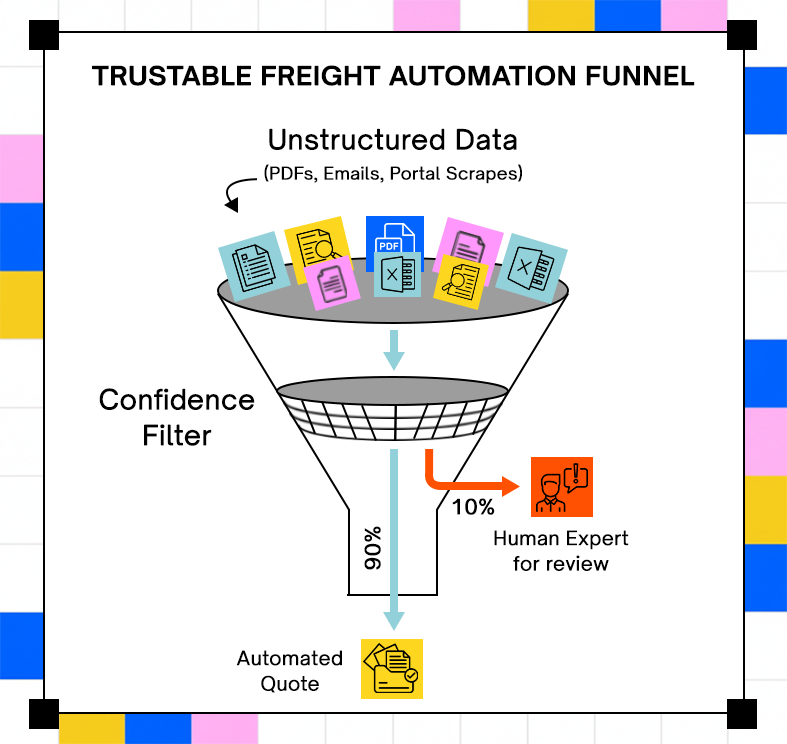
Agentic automation that runs entirely without human oversight in financial workflows is an architectural risk, not a feature. Production freight rate agents need configurable confidence thresholds that route certain outputs to human reviewers before quotes are sent. The design pattern, which Adopt AI calls "human in the loop," is what separates reliable production automation from demo environments that look clean until an edge case appears.
Agents flag outputs for human review when a carrier returns a rate that deviates significantly from the historical range for that lane, when surcharge clauses use language outside the training vocabulary, when validity windows are shorter than the customer's requested period, or when the confidence score on a document extraction falls below a set threshold. Reviewers see the full investigation report, not just a flag: the extracted rate, the comparison against historical data, and the specific clause that triggered the review.
The threshold calibration is a judgment call, and it has a direct financial implication in both directions. Set the threshold too conservatively and the system creates more review tasks than it eliminates, providing no real throughput benefit. Set too loosely and financially significant exceptions route to customers without a human check, which on a high-volume lane can compound into a meaningful revenue exposure before anyone notices.
Rate Trend Visibility and Scheduled Data Pulls
Freight pricing isn't static, and a rate pulled last week may not be competitive today. Adopt AI's system runs daily scheduled pulls across 150+ common routes, maintaining a 90-day historical window that allows rates to be visualized as trend lines rather than point-in-time snapshots. Reps can query the system in natural language ("What's the current range for 40ft containers from Shanghai to Los Angeles?") rather than building pivot tables from exported spreadsheets.
The competitive pressure behind data freshness is real. Shippers in 2026 expect response times measured in minutes, not hours or days. Forwarders who respond to a rate request within two minutes convert more bids than those who take two hours, and that gap widens on time-sensitive lanes where cargo is ready to move. Stale rate data doesn't just look unprofessional: it means quoting customers on rates that carriers may no longer honor, creating disputes before the shipment even begins.
AI-Driven Freight Invoice Processing and Dispute Resolution
Invoice validation is the second major freight automation domain, and it's arguably the one with more direct financial recovery potential. According to Adopt AI's freight invoice use case, each billing dispute currently consumes over 30 minutes of investigation time. For logistics companies processing thousands of invoices monthly, that compounds into a significant portion of the finance team's capacity, much of it spent on disputes that could have been resolved in seconds with the right contract context.

The financial exposure is substantial. Companies that audit only a sample of invoices due to time constraints miss overcharges that go unrecovered. Dow Chemical's deployment of invoice analysis agents, as reported by Microsoft's supply chain blog, involves agents reviewing thousands of freight invoices daily and has saved the company millions across its global shipping network.
The Technical Anatomy of a Freight Billing Dispute
Freight billing disputes are harder to automate than they appear because the resolution requires cross-referencing three systems that don't talk to each other: the invoice (in PDF, Excel, or EDI format), the shipment record in the ERP, and the contract terms stored somewhere in Google Drive, a shared folder, or a file server.
Accessorial charges, detention fees, fuel surcharges, and port congestion surcharges each require interpretation against tiered rate tables in the specific carrier agreement, not a generic tariff schedule. A charge code that maps to one rate under one contract maps to a different rate under a different agreement with the same carrier. Generic RPA tools fail here for the same reason they fail in rate extraction: they're designed for data entry operations, not for decisions that require contextual interpretation of contract language against line-item invoices.
Adopt AI explicitly addresses this distinction in its freight invoice use case. The platform understands freight-specific workflows like "validating accessorial charges against carrier contracts, mapping container tracking to invoice line items, and interpreting rate tables with tiered pricing." Generic automation treats invoices as data entry. Agent-based freight automation treats them as operational decisions requiring contract context.
How Invoice Validation Agents Cross-Reference Contracts Against Line Items
The agent-driven dispute workflow runs in six steps. First, the agent monitors the dispute inbox and extracts the invoice number, the claimed charge discrepancy, and the relevant charge code from the inbound email. Second, the agent fetches the disputed invoice from the ERP and parses every line item, identifying which charges are contested. Third, the agent searches Google Drive or the document repository for the specific freight agreement governing the carrier relationship. Fourth, the agent reads the agreement's rate table and extracts the terms applicable to the disputed charge type. Fifth, the agent constructs a structured breakdown: which line items match the contract, which deviate, and by how much. Sixth, the output is a structured investigation report with the full evidence chain attached, not a raw document dump that still requires a human to read and interpret.
For disputes involving credit amounts above a defined threshold or contract language that requires interpretive judgment, the agent routes the complete investigation report to the finance team via dashboard or Slack notification. The reviewer sees the agent's recommended resolution and can approve, modify, or override it. Adopt AI's claim of 16x time savings on dispute processing reflects the difference between this workflow and a team member manually downloading the invoice, searching for the contract, reading the rate table, and drafting a response from scratch.
Auto-Drafted Resolution Emails and Credit Note Tracking
After the investigation, the agent generates a carrier response email. If the carrier's charge is valid per the contract, the email confirms it. If the carrier overbilled, the email specifies the exact overcharge amount, references the contract clause and rate table that establishes the correct charge, and formally requests a credit note. The supporting documents (contract excerpt, rate table, shipment timeline) are attached automatically.
The gap that most manual workflows leave open is what happens after the resolution email is sent. Without automation, there's no systematic follow-up to confirm that credits were issued, invoices were adjusted, or overpayments were actually recovered. Agents close that tracking gap by maintaining a resolution state for each dispute: detection, investigation, response, credit confirmation. The difference between a resolved dispute and an unrecovered overcharge often comes down to whether anyone remembered to follow up.
Deployment Architecture: Cloud, On-Premise, and VPC Considerations for Freight Platforms
Deployment architecture decisions for freight automation are more consequential than in most enterprise software categories because of what the data contains. Carrier contract rates represent negotiated commercial agreements that, if exposed to the wrong parties, can damage carrier relationships and reveal competitive positioning. Some enterprise freight platforms operate under agreements that prohibit customer data from leaving a defined perimeter.
The architecture question directly determines which parts of the organization can participate in the automation, how quickly the system can be updated, and what the InfoSec approval process looks like. Adopt AI supports cloud, on-premise, and hybrid deployment configurations, addressing the full range of enterprise requirements.
When On-Premises Deployment Is a Hard Requirement
Helm-based deployment inside a customer's VPC is the relevant mechanism for freight platforms where data sovereignty is non-negotiable. In an on-prem deployment, the agent execution layer, the rate aggregation logic, and the contract document retrieval all operate within the customer's network boundary. Carrier rate data and contract terms never traverse to an external cloud environment.
The tradeoff is operational: on-prem deployments require the customer's IT team to manage the infrastructure, apply updates, and handle the compute capacity for agent execution. Cloud deployments get updates automatically and don't require internal infrastructure investment, but they require the customer to accept that rate and contract data will transit to the vendor's environment. For mid-market freight forwarders without dedicated InfoSec teams, cloud deployment is the practical default. For enterprise logistics providers under strict data governance frameworks, on-prem is often the only viable path through the security review process. Adopt AI's explicit support for Helm-based VPC deployment is, in practice, what allows these enterprise deals to progress at all.
Integrating Agents With Existing TMS and ERP Systems Without Replacing Them
The most consistent objection logistics IT teams raise when evaluating freight automation is the sunk cost in existing systems. CargoWise, SAP TM, and Oracle TM represent years of configuration, data migration, and workflow customization. The prospect of replacing them to accommodate an automation layer is both financially and operationally untenable.
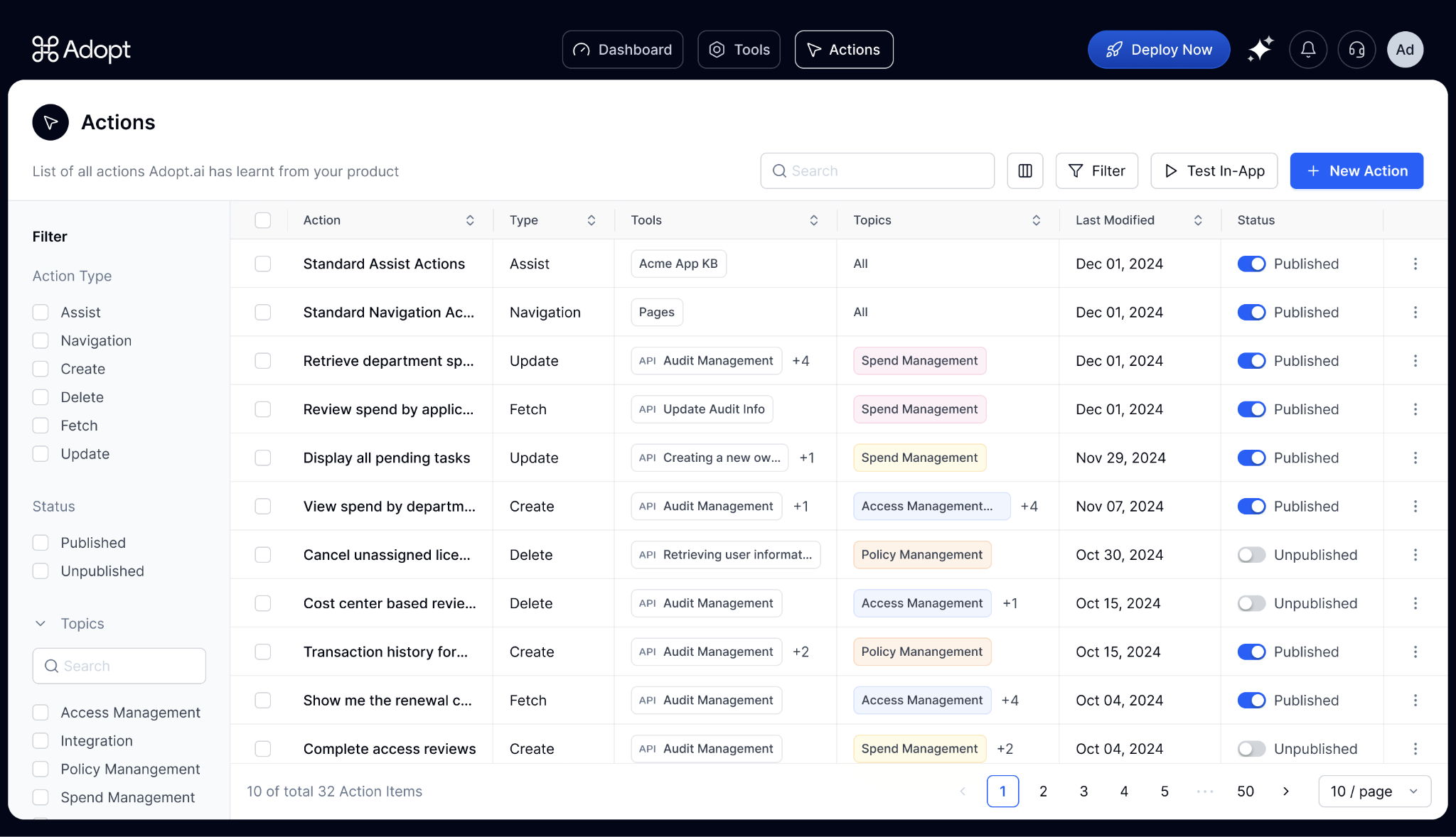
From the Actions tab inside the Agent Builder, you’ll see a full list of all the Actions Adopt has generated for your app.
Adopt AI's deployment model treats the existing TMS and ERP as action targets rather than replacement candidates. Where target systems expose APIs, the agents use API-based connectors. Where they don't, Zero-Shot Discovery handles interaction without documentation. Webhook-based events trigger fire agents when invoices arrive, when rate validity periods expire, or when new carrier emails land in monitored inboxes.
One customer described the experience as: "the aha moment was realizing we didn't need to rebuild anything. Adopt fit right in and extend what we'd already built." That's the architectural principle: the automation layer plugs into the existing stack's surface area rather than beneath it.
Observability, Audit Trails, and Governance in Agent-Driven Freight Workflows
Production governance for agent-based financial workflows isn't optional. Adopt AI's platform provides full observability and auditability per its production controls documentation, including per-action audit trails, approval checkpoints before high-value operations, Slack-integrated exception notifications, and per-agent kill switches.

The reason governance matters specifically for freight is the compounding failure mode. A rogue agent sending incorrect quotes to 100 customers in a 10-minute window isn't a dashboard error. It's a commercial and reputational problem that requires manual remediation across every affected relationship. Approval checkpoints before quote sends and credit note requests, combined with audit trails that capture every agent action with timestamp and confidence score, are what allow logistics leadership to trust that agents are executing correctly without watching every action live.
Measuring Freight Automation ROI
Headline metrics like "80% time saved" have their place in procurement conversations. For engineering and operations leads building the business case internally, more granular measurements are needed: ones that connect specific agent behaviors to specific financial outcomes, and ones that distinguish between capacity improvements and error-rate improvements.
Operational Throughput Metrics Versus Efficiency Ratios
The primary throughput metric is quotes processed per rep per hour, measured before and after automation deployment, segmented by route complexity (standard lanes versus multi-leg, multi-carrier queries). Secondary metrics include time-to-quote by lane type, exception rate (the percentage of agent executions that require human review), and carrier onboarding time for new portals.
The distinction between throughput metrics and error-rate metrics matters financially. A team that processes 10x more quotes but at the same error rate simply has 10x the exposure. A team that processes 3x more quotes at one-fifth the error rate has both higher revenue potential and lower financial risk. Adopt AI cites 90% reduction in manual hours per rate request and 10x higher capacity with the same headcount, both throughput improvements. The error rate reduction from automated surcharge detection (floating clauses flagged before customer quotes are generated) is the financial risk reduction metric that belongs alongside those numbers.
Financial Recovery Metrics in Invoice Dispute Automation

The key metric for invoice automation isn't how fast disputes are resolved. The key metric is what percentage of invoices are audited. Before agent-based automation, most freight platforms audit a sample of invoices due to time constraints, meaning overcharges on the unaudited portion simply go unrecovered. After deployment, every invoice is auditable, and the recovery rate on overcharges becomes a measurable financial line item.
Supporting metrics include cycle time from dispute detection to credit note receipt, dollar value of overcharges recovered per month versus baseline, and the percentage of disputes resolved without human escalation. Dow Chemical's deployment, which involves reviewing thousands of invoices daily and recovering millions across its shipping network, is the scale benchmark for what full-coverage invoice auditing looks like at enterprise volume.
Time-to-Value and the Carrier Onboarding Dependency
The implementation timeline for freight automation depends primarily on one variable: how many carriers need onboarding, and how accessible their portals are. ZAPI-based onboarding runs at 24 hours per carrier, compared to weeks for traditional connector builds. For a forwarder covering 50 carriers, the difference is the system becoming operational in 50 days versus roughly a year.
The other dependency is data quality. Agents pulling rates from carrier portals will aggregate correctly only if the route and container type parameters in the originating request match what the portal expects. Freight platforms with clean, standardized internal data reach production faster. Those with inconsistent internal data schemas spend the first few weeks of deployment on data normalization rather than carrier onboarding. Both factors determine when the ROI clock actually starts.
Conclusion
Freight automation in 2026 is no longer an experimental category. The workflows involved in rate fetching, invoice validation, dispute drafting, and carrier onboarding are well-defined enough for agents to handle the heavy lifting, with humans handling the exceptions that require judgment. We covered why legacy iPaaS and RPA tools fail at the three structural gaps specific to freight (portal instability, format heterogeneity, and ERP rigidity), how Adopt AI's ZAPI capability addresses carrier onboarding without documentation, what the end-to-end rate aggregation and invoice dispute workflows look like in a production system, and what deployment architecture decisions logistics platforms face when data sovereignty is a constraint.
The real decision for engineering and operations teams isn't whether agents can handle these workflows. The real decision is whether to deploy a purpose-built execution layer that understands freight-specific data structures and carrier portal behavior, or to attempt to bolt together generic automation tools that will require constant maintenance every time a carrier changes its interface. Teams that separate the data layer from the execution layer, configure human-review thresholds correctly, and deploy with full audit trails get to production reliability. Teams that skip those foundations get to demos.
FAQs
1. How Does Zero-Shot API Discovery Work for Onboarding New Carrier Portals in Freight Automation?
Zero-Shot API Discovery (ZAPI) allows agents to understand a carrier portal's API structure and behavior automatically, without pre-built connectors or documentation. Adopt AI states the process onboards a new carrier in 24 hours. When a portal changes its interface or authentication flow, the agent adapts rather than breaking, eliminating the developer sprint that traditional connector-based systems require.
2. What Is the Difference Between RPA and AI Agent-Based Freight Invoice Processing?
RPA follows a fixed script against a predictable interface. It treats invoices as data entry targets, extracting field values based on predefined positions. AI agents, by contrast, interpret the invoice's content in context, cross-reference contract terms, reason about whether a charge is correct under a specific carrier agreement, and generate a structured resolution recommendation.
3. Can Freight Automation Agents Integrate With CargoWise, SAP TM, or Oracle Without Replacing Them?
Yes. Adopt AI's architecture treats existing TMS and ERP systems as action targets rather than requiring replacement. Where APIs exist, agents use API-based connectors. Where they don't, Zero-Shot Discovery handles the interaction. Webhook triggers fire agents on events like new invoice arrivals or rate expiry without modifying the underlying TMS configuration.
4. How Do Human-In-The-Loop Controls Work When Agents Are Processing High-Volume Freight Quotes?
Agents apply configurable confidence thresholds to each output. When a rate deviates significantly from historical data for a lane, contains unfamiliar surcharge language, or falls below the extraction confidence threshold, the system routes the full investigation report to a human reviewer rather than sending the quote automatically. Reviewers see the evidence, the agent's recommendation, and the specific trigger for escalation, and can approve or override before the quote reaches the customer.

.svg)
.svg)


Take three minutes to find out which side of that line you are on.
Browse Similar Articles


Find Your Agentic AI Readiness Score
Every enterprise thinks they are building toward Agentic AI. But only few actually are.
Take three minutes to find out which side of that line you are on.