
What is Business Process Automation (BPA)? [A 2026 Guide]

Garrett Moedl
Founding Product Marketer17 March 2026

TL;DR
- Rule-based Business Process Automation (BPA) encodes assumptions made at build time. Regulatory shifts, SaaS API changes, and reorgs invalidate those assumptions faster than rule sets can be updated, and the automation built to cut manual work ends up requiring it.
- Rule-based systems often become cost centers. As complexity grows, the risk of cascading failures prevents teams from updating the logic, leaving the automation stuck in a version of the process that no longer exists.
- Legacy BPA often reports "green" status while writing malformed data into downstream systems. These silent failures create audit gaps that only surface weeks later.
- Unlike stateless pipelines, agentic architecture carries human decisions forward as metadata. This ensures human review is a feedback mechanism that improves the process instead of just a temporary patch.
- By acting on live application surfaces instead of static models, agents eliminate the need for constant manual connector updates and rule re-mapping.
Enterprises running BPA (business process automation) today are not losing sleep over adoption. They are losing sleep over what happens the morning after go-live, when the exception queue has tripled, the rule set nobody fully understands breaks again, and the team that built the workflow has moved on. According to Gartner, 30% of enterprises will automate more than half of their network activities by 2026, up from under 10% in mid-2023. Yet the same research notes that less than 20% of organizations have mastered measuring the outcomes of those automation initiatives. Spending is up. Confidence in what that spending delivers is not.
The strategic role of BPA in business operations has grown significantly, yet the gap between investment and measurable outcomes continues to widen. The intelligent process automation market is projected to reach $44.74 billion by 2030, growing at a 22.6% CAGR, and the platforms competing for that budget are more capable than ever. The problem is architectural. Rule-based automation was designed for stable process environments, and enterprise environments stopped being stable sometime around the time cloud migration, API-first SaaS vendors, and M&A activity converged into a continuous state of process change.
This article covers what rule-based BPA was actually built for, where it breaks under enterprise conditions, why those breaks are structural rather than fixable with better configuration, and what the execution model looks like when it actually holds at scale.
What Is Business Process Automation (BPA)?
Business process automation (BPA), at its full definition, covers the end-to-end execution of repeatable business processes: event triggering, conditional routing, cross-system orchestration, decision logic, exception handling, and confirmed downstream action. Every step in that chain has to work for the process to be automated in any meaningful sense.
Understanding BPA meaning in business goes beyond simple task automation. It encompasses the full spectrum of how organizations systematize their operations — from routine data entry and approvals to complex multi-system orchestration spanning finance, HR, legal, and operations. Most platforms deliver the first two; triggering and routing are well-solved problems. Everything from conditional logic onward tends to get handed off to custom integrations, hardcoded rules maintained by whoever built the original workflow, or humans working a queue that the automation was supposed to eliminate. When a vendor markets "automate your workflows," they are usually describing automating the structured, predictable portion of a process and routing the rest to a team that handles it manually.
That split matters because the portion that gets routed to humans is rarely random. It is the portion where the process touches ambiguity, variation, or a condition that was not anticipated when the rules were written. Over time, that portion grows. The manual workload that was supposed to shrink after automation goes live ends up expanding, because the ruleset can only handle what it was trained to expect.
Why Rule-Based Systems Were Built for a World That No Longer Exists
Every rule in a BPA workflow system encodes an assumption. Every conditional is a bet that a specific condition will stay true long enough to be worth encoding. When rule-based BPA was being designed and adopted at scale in the 2010s, that bet was reasonable. Enterprise systems changed slowly, vendor APIs were relatively stable, and organizational structures held their shape for years at a time.
That environment no longer exists for most enterprises. Regulatory cycles now move faster than rule maintenance cycles. SaaS vendors push API changes without the deprecation windows that on-premise systems once required. Acquisitions bring incompatible process architectures into the same automation layer overnight. The automation that was supposed to reduce human involvement ends up requiring continuous human maintenance just to stay current with the conditions it was built to handle.
Where Rule-Based BPA Actually Breaks, And Why Scale Is the Trigger
The failure modes of rule-based BPA are not random. They follow a predictable pattern, and the trigger in almost every case is scale, more processes, more document types, more systems in the chain, more edge cases per workflow. Understanding why helps clarify what a replacement architecture actually needs to solve.
Why Exception Queues Grow Instead of Shrinking After Automation Goes Live
Rule-based systems handle the cases they were designed for. Every case outside that set becomes an exception. At low volumes, exception queues are manageable, a small team can work through them, corrections get made, and the backlog stays under control. At scale, those same queues become the dominant workload.
This is the outcome that does not appear in vendor case studies: automation sold on the basis of exception reduction produces exception growth because the process environment has drifted from the assumptions encoded at deployment. Teams respond by adding headcount to work the queues. The ROI calculation gets revised. The automation is now a cost center managing its own failure rate, and the business has traded one manual process for a more expensive one, with higher infrastructure costs sitting underneath it.
A 2025 analysis of BPA adoption data found that 78% of businesses believe complex workflows actively complicate automation, and that the average organizational workflow in 2025 includes over 50 components, 19% more than in 2020. Each additional component is another integration point where rules can break, and exceptions can be generated.
The Maintenance Compounding Problem Nobody Budgets For
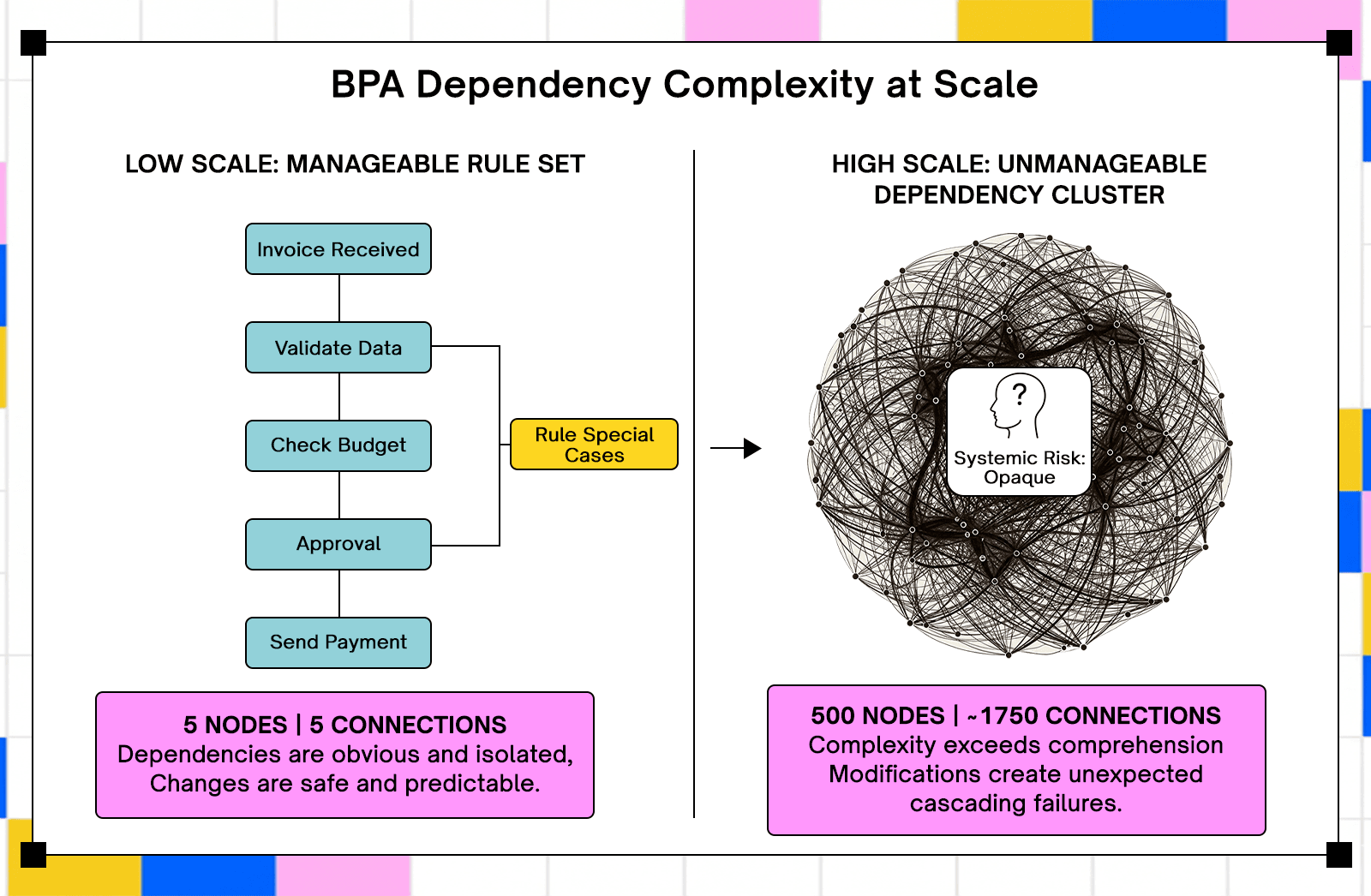
Adding a rule to handle a new edge case creates a dependency on every rule it touches. At 50 rules, the dependency map is navigable. At 500, no single person has a complete picture of which changes affect which. Teams stop modifying workflows not because the workflows are working well, but because the risk of cascading failures is too high. New edge cases get routed to humans by default because nobody wants to be responsible for breaking the accounts payable workflow two days before month-end close.
This is process calcification. The automation is still running. It just stopped representing how the business actually works. And because the rule set has become too complex to safely modify, it stays that way indefinitely, a brittle structure that the business builds workarounds around rather than a system it relies on.
The BPA market guide published by Gartner notes that vendors continue to acquire adjacent capabilities to address this, such as low-code tools, RPA layers, and process mining, but each addition adds its own maintenance surface. The underlying problem, that rules require human upkeep proportional to the rate of process change, does not get solved by adding more tooling on top.
Cross-System Orchestration and the Integration Brittleness Problem
A single BPA process process typically touches between four and eight systems before it is complete. An invoice approval might move through an email inbox, a document store, an ERP, a payment processor, and a compliance log in a single execution. A contract renewal might span a CRM, a legal repository, a DocuSign workflow, and a finance system before it closes. In BPA project management contexts, this cross-system dependency is even more pronounced: tasks, approvals, resource assignments, and status updates must stay synchronized across platforms in real time, and a single stale rule can cascade failures across an entire project lifecycle.
Rule-based orchestration across those systems assumes three things that do not hold reliably in production: stable APIs, consistent field schemas, and predictable response behavior from every system in the chain. Any one of those systems can change without notice, a SaaS vendor pushes a schema update, a field is renamed in a downstream system, an API endpoint is deprecated, and the entire workflow breaks at the integration point.
The failure mode here is particularly damaging because it is often silent. The workflow frequently completes without throwing an error while writing malformed or misrouted data downstream. The problem surfaces weeks later in a financial report, a compliance audit, or a customer complaint, with no audit trail connecting the data error back to the automation step that caused it.
Decision Logic That Encodes Yesterday's Judgment Calls
Every routing rule in a BPA workflow represents a decision that someone made at build time. That decision was correct when it was made. By the time it runs in production six months later, it may reflect a revised threshold, a reorganized team structure, or a vendor relationship that no longer exists.
A rule that escalates contracts above a certain value does not know the threshold was adjusted in Q3. A rule that routes tasks to a specific approval team does not know that team was restructured after a reorg. A rule that flags specific vendor IDs does not know the vendor was acquired and reissued under a new ID in a different ERP record.
Keeping rules current requires a functional chain of awareness: someone has to know the business condition changed, know which rules it affects, find those rules in the workflow system, and update them before the next execution cycle that would produce the wrong outcome. At enterprise scale, that chain breaks constantly, and nobody knows it has broken until a process produces a result that someone downstream notices is wrong.
Why Traditional BPA Architecture Makes These Problems Structural
The failure modes above are not implementation errors. They are predictable consequences of architectural choices that were reasonable when BPA was first designed but do not hold under the conditions that enterprise deployments now operate in.
Each of these three structural limitations compounds the failures described above, which is why patching one without addressing the others tends to produce marginal improvements rather than systemic change.
Stateless Pipelines That Lose Context the Moment a Human Touches Them
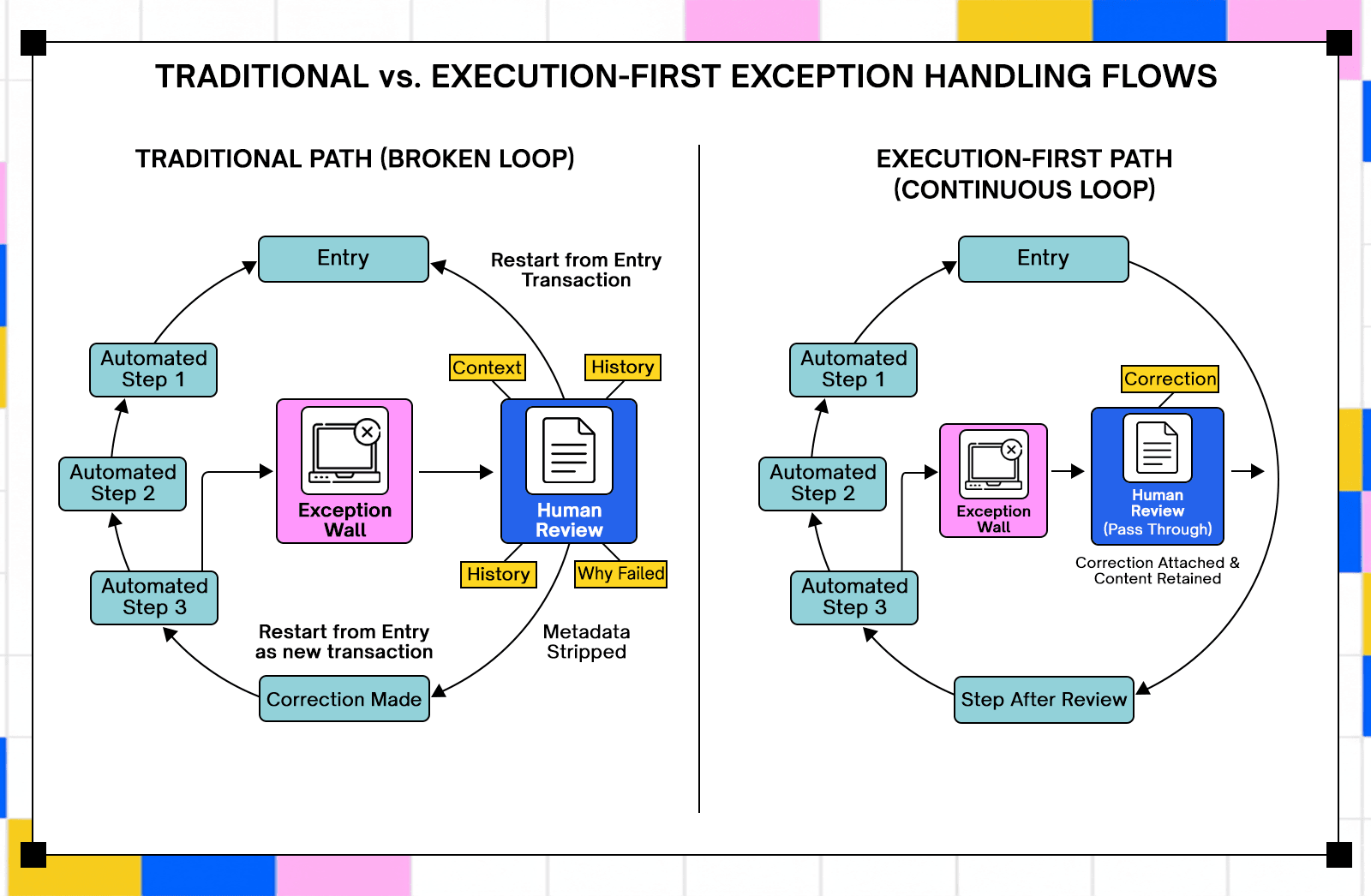
When a process step fails and routes to human review, most BPA platforms hand off a task stripped of its execution context. The reviewer sees the decision that needs to be made, not why the system could not make it, what steps were already completed, or what downstream dependencies are waiting on the outcome.
After the reviewer acts, the process typically re-enters the pipeline from the beginning. The correction is recorded as an event. The execution context that would have told the system what changed and why is discarded. The same process type will fail the same way on the next transaction, because nothing about the review step was connected to the logic that caused the failure.
Human review modeled outside the execution pipeline is a patch on the output. It is not a feedback mechanism on the process. Teams that have built mature BPA implementations know this, which is why manual review queues in large deployments tend to be permanent infrastructure rather than temporary catch-nets.
Observability That Ends at the Workflow Boundary
BPA platforms report on workflow execution: steps completed, SLAs met or missed, exceptions routed, volumes processed. What they do not report is what downstream systems did with the data produced by those workflows.
A workflow that completes successfully when writing a malformed payload to an ERP is marked as successful in the automation dashboard. The data error surfaces in a financial report three weeks later with no trace back to the automation step that caused it. Compliance teams trying to reconstruct that error path are working from two incomplete log systems that were never designed to be read together.
That visibility gap is where compliance risk accumulates silently. It is also why the true cost of BPA failures is consistently underestimated; most of it does not register in the automation platform at all.
No Mechanism for Execution to Inform Process Design
When a human overrides an automated decision, that signal almost never reaches the process model. The override is logged as an event. The rule that produced the wrong decision stays in place, unchanged, ready to produce the same wrong decision on the next matching transaction.
Over time, the delta between what the workflow does and what the business needs widens. The workflow becomes a constraint that the business routes around rather than a system it builds on. New processes get designed to avoid the automation layer rather than leverage it, because the cost of maintaining rules has made the automation team a bottleneck rather than an enabler.
What the Architecture Looks Like When It Actually Holds at Scale
Moving past rule-based BPA does not mean abandoning structure or governance. It means relocating where the intelligence lives, from a static rule set that must be manually maintained to an execution layer that reasons about the current state of the systems it operates on.
Traditional rule-based BPA versus agentic BPA
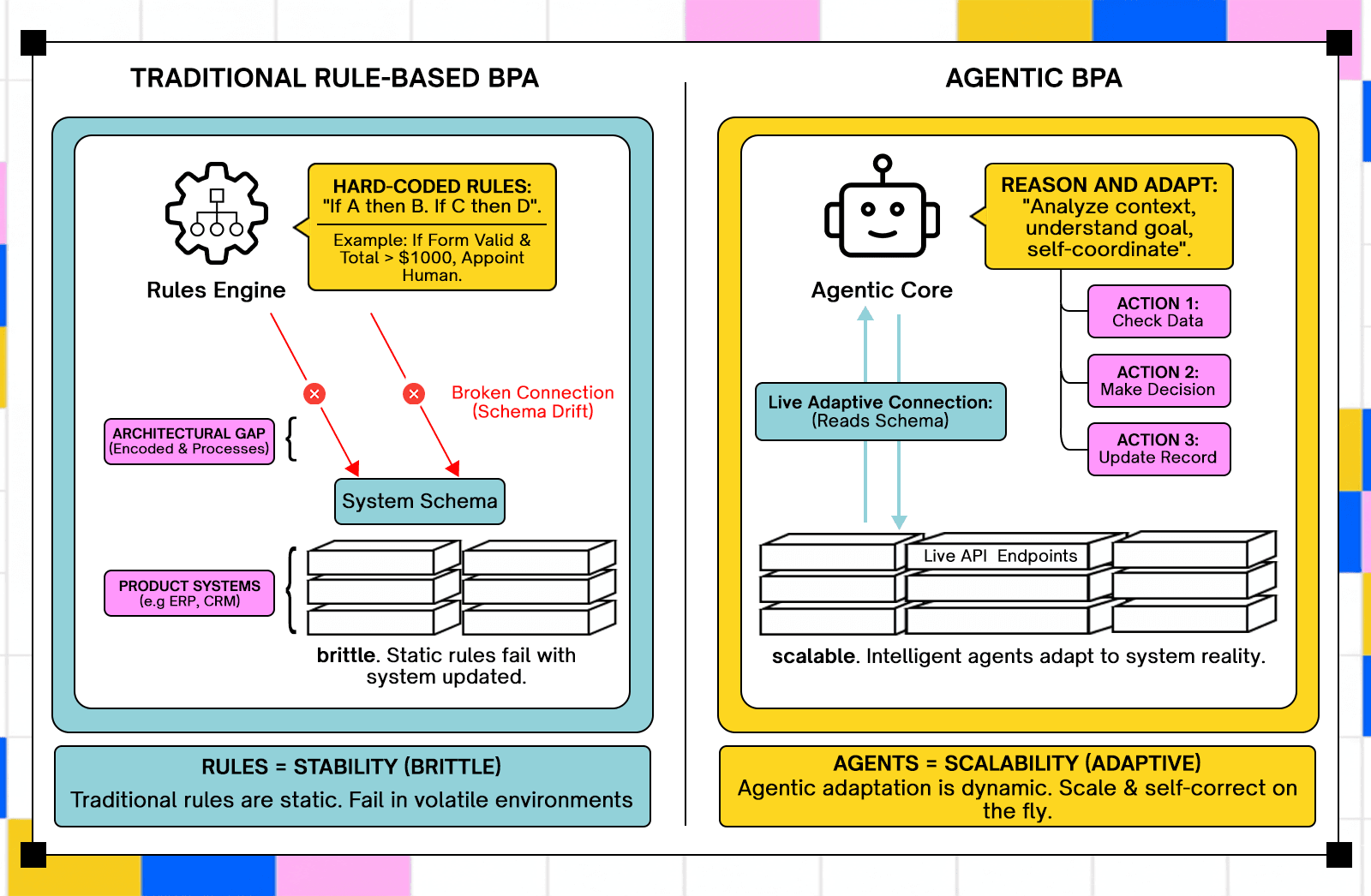
The architectural shift that enables BPA automation to scale at enterprise volume is treating automation as an execution problem rather than a process-modeling problem. Instead of building a model of how a process should behave and encoding that model as rules, agents act directly within the systems where the process runs.
This distinction matters for a specific reason: when a system changes, an execution-first agent adapts to the current state of that system rather than failing against a schema that was accurate at build time. There is no static connector to re-map. There is no rule to update. The agent discovers the current capability surface and acts against it.
Gartner's top strategic technology trends for 2026 specifically identifies multiagent systems as the mechanism by which organizations will automate complex business processes at scale, noting that agents that can reason, adapt, and coordinate across systems enable a form of automation that deterministic rule sets cannot match.
Process Context That Survives System Boundaries and Human Interruptions
Execution that carries context across system handoffs and human review steps does not restart from scratch when something unexpected happens. The agent knows what triggered the process, what actions have already been taken, and what the downstream systems currently expect. When a human makes a correction, that correction travels forward as part of the execution state, not as an isolated event that the system forgets before the next cycle.
This is what closes the feedback loop that stateless pipelines leave open. Corrections made during human review become signals that shape how the next similar transaction is handled. The system does not learn from a model training cycle; it learns from an execution state that is preserved and carried forward.
How Adopt Approaches Enterprise-Scale Business Process Automation
Adopt builds BPA as an execution layer that operates against live application surfaces rather than static process models. Agents use zero-shot discovery to automatically understand APIs and system data without requiring connectors or scripts to be built and maintained. Actions are generated from that discovery and verified through execution, meaning the system validates outcomes and recovers when systems change, rather than failing silently against stale schemas.
The agentic automation layer supports several execution patterns relevant to enterprise BPA: CRUD agents for creating, reading, updating, and reconciling data across systems; triggered background agents that respond to webhooks, schedules, and system events; long-running agents that maintain state across multi-hour or multi-stage workflows spanning multiple approvals; and goal-oriented agents that pursue business outcomes with guardrails that ensure safe, predictable execution.
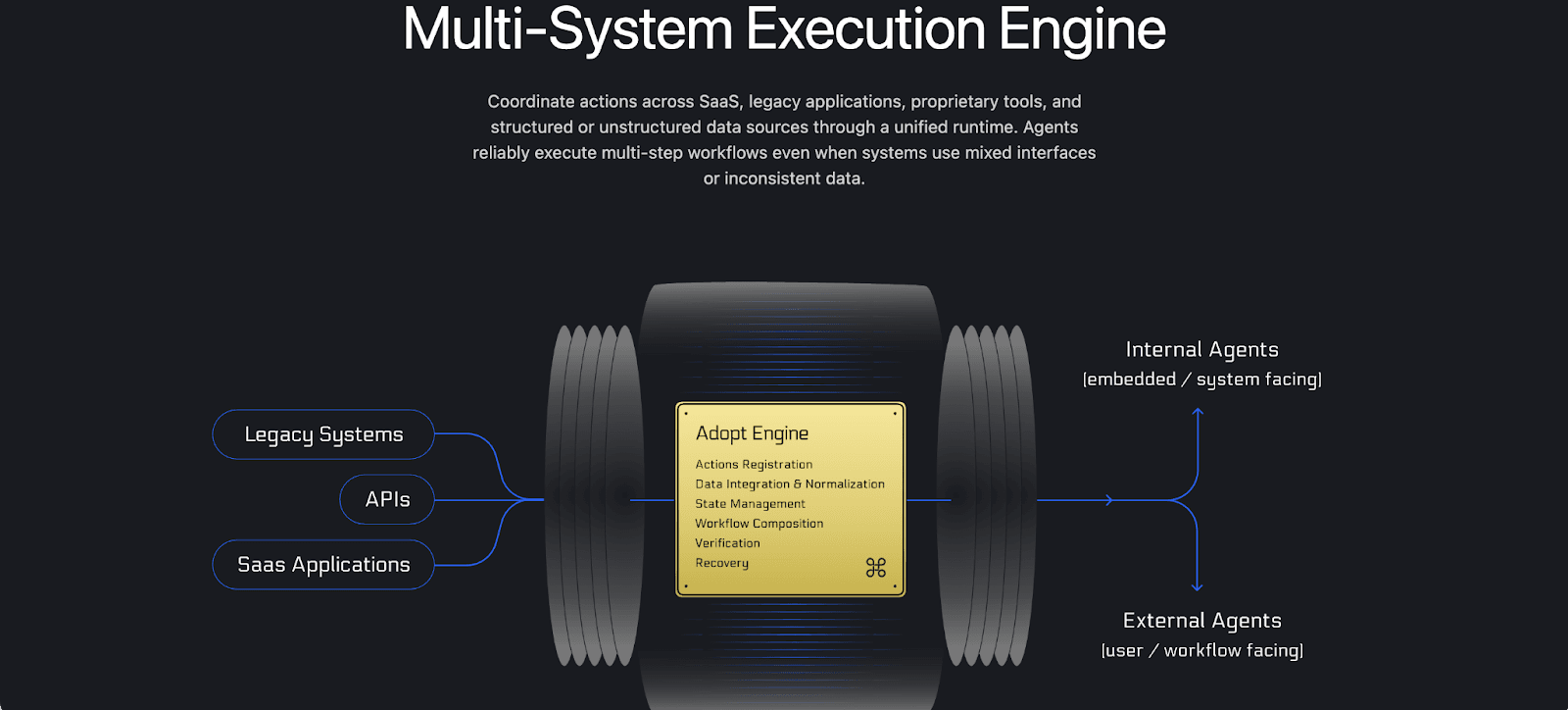
Human review is treated as a first-class execution state rather than a pipeline exit. When a process requires human judgment, Adopt's human-in-the-loop approval system escalates exceptions without losing workflow continuity, reviewers see why processing paused, and when they act, the workflow resumes with their decision carried forward as context rather than restarting from zero.
Governance is built into execution rather than reconstructed from logs after the fact. Every agent action is logged with scope, intent, and outcome. Access controls are scoped per agent, per process type, and per downstream system through RBAC-managed publishing rights, so compliance teams have a complete audit trail without requiring a separate logging infrastructure to produce it.
Across production deployments, Adopt reports 10x faster cycle times, 85% of tasks eliminated, and over 200 hours saved per month, outcomes that reflect the difference between patching a rule-based pipeline and replacing the architecture underneath it.
Conclusion
Rule-based business process automation delivered real value when enterprise environments were stable enough for static rules to stay accurate. They are not stable in that way anymore, and the result is a generation of BPA deployments that require more maintenance than most teams budgeted for, produce exception queues that grow faster than the capacity to work them, and break in ways that surface downstream rather than at the source.
The structural limits covered here, stateless pipelines, closed observability, rule sets that cannot self-correct, are not fixable through better configuration or additional tooling layered on top of the same architecture. The shift toward execution-first, context-aware BPA automation is not a product trend, but it is a response to the specific failure modes that rule-based design produces at enterprise scale.
FAQs

Related Articles

The AI CFO Tech Stack: What Finance Leaders Are Actually Running in 2026


How to Become an AI CFO: A 12-Month Roadmap


See it running on your workflows
Automate your accounting workflows