

AI agents can reason, but most still struggle to access enterprise systems. Learn why operational access is the next challenge in AI.


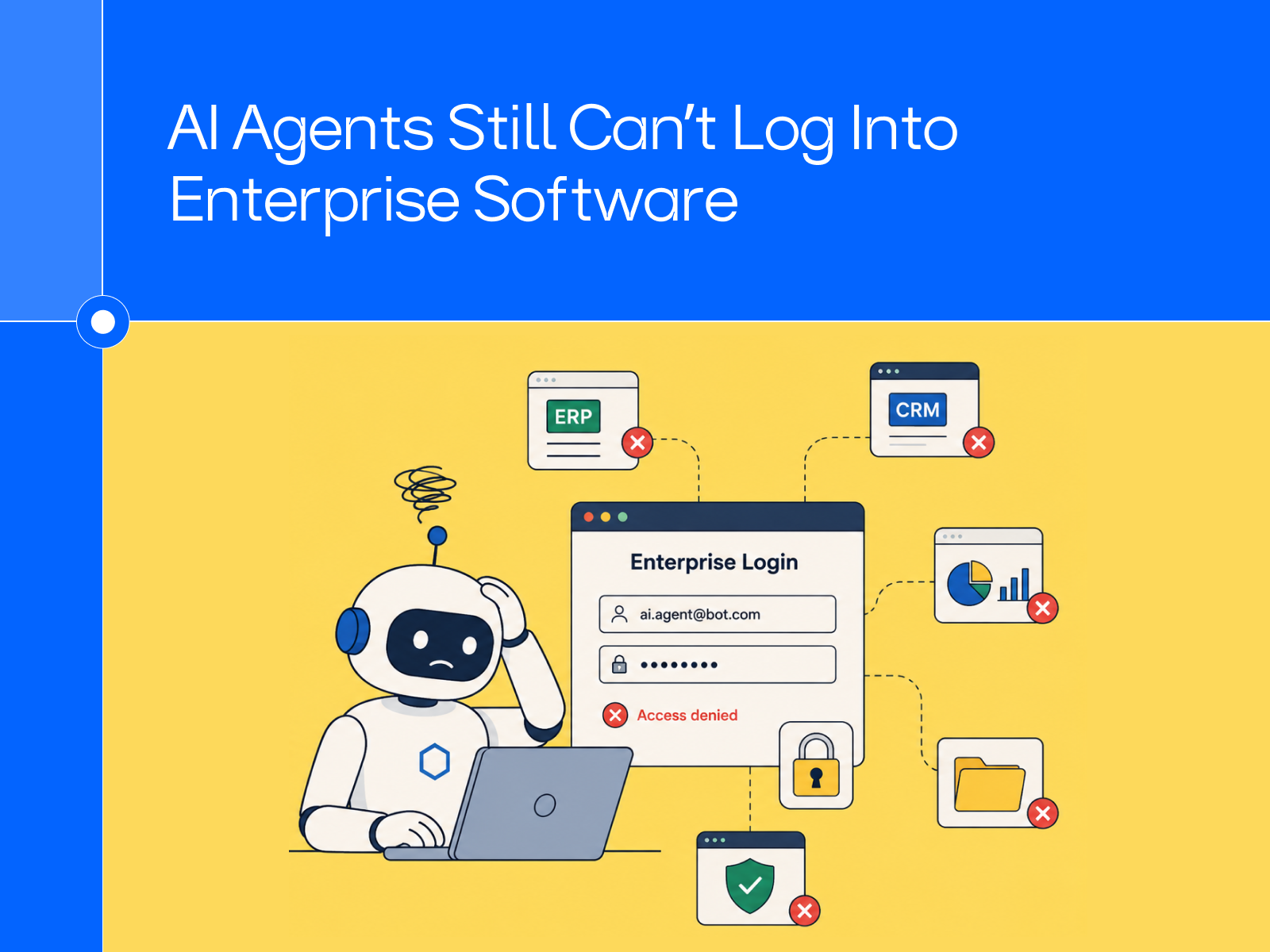
Why authentication and operational access have become the next major challenge in agentic AI
The AI industry has spent the last several years focused on reasoning. Large language models can summarize documents, generate code, orchestrate workflows, and make increasingly sophisticated decisions. Nearly every new platform in the market now claims to be “agentic,” promising a future where AI systems autonomously complete work on behalf of employees.
Enterprise adoption is now exposing a much more practical problem.
AI agents still struggle to reliably access and operate inside the systems where business actually happens.
The issue is not reasoning capability. The issue is operational access. Most enterprise applications were never designed for autonomous software agents. Business workflows still rely heavily on browser-based interactions, fragmented authentication models, expiring sessions, multi-factor authentication prompts, rotating credentials, and interfaces that constantly evolve.
Even modern enterprise environments continue to depend on systems with incomplete APIs or no APIs at all.
The market solved intelligence faster than it solved execution.
Enterprise Work Does Not Happen in APIs Alone
Enterprise operations span fragmented SaaS platforms, internal web portals, logistics systems, ERP environments, and legacy applications that were never designed to support autonomous AI systems.
Sales teams move between CRMs, prospecting platforms, and internal tools. Supply chain organizations rely on carrier portals, logistics systems, and browser-based operational workflows. Finance and operations teams regularly work across disconnected applications with inconsistent authentication requirements and limited interoperability.
Most enterprise environments still depend heavily on browser-based access.
Browser authentication introduces operational complexity that traditional AI infrastructure does not solve. Multi-factor authentication prompts, expiring cookies, rotating sessions, CAPTCHAs, and evolving login flows create persistent reliability challenges for AI-driven automation.
The market has made significant progress helping AI systems reason about work. Far less attention has been paid to how AI systems reliably gain and maintain secure access to the applications where work actually occurs.
Authentication and session continuity are quickly becoming foundational infrastructure problems for enterprise AI adoption.
The Execution Bottleneck Nobody Talks About
Before an AI agent can automate a workflow, retrieve information, or execute a task, the agent first needs reliable access to the target application.
Historically, enterprises solved that challenge by building fragile custom integrations for every individual system. Engineering teams reverse-engineered login flows, maintained session refresh logic, managed browser edge cases, and rebuilt automation whenever authentication flows changed.
Traditional automation approaches became increasingly difficult to scale as enterprise environments grew more dynamic and fragmented. Reliability deteriorated rapidly once workflows extended across multiple applications and browser-based systems.
Many AI agents already know what actions to take.
Reliable operational access remains the larger unsolved problem.
The implications are much larger than authentication alone. Enterprises cannot scale agentic AI if every application requires weeks of custom engineering and ongoing operational maintenance. APIs remain important, but APIs alone do not reflect how enterprise work actually happens today.
Enterprise execution still lives inside browsers.
The Market Is Shifting From Intelligence to Execution
The first wave of enterprise AI focused on model capability. Vendors competed on reasoning quality, copilots, summarization, orchestration, and workflow generation.
The next phase of the market will be defined by operational execution.
Enterprises are rapidly discovering that reasoning alone does not create business outcomes. AI systems must also operate reliably across the fragmented environments where work already exists. Authentication, session continuity, governance, operational resilience, and cross-system execution are becoming foundational infrastructure requirements for enterprise AI deployment.
The enterprise AI stack is evolving beyond models and orchestration layers alone.
Organizations now require operational infrastructure that allows AI systems to securely access applications, maintain persistent context, navigate authentication complexity, and execute reliably across dynamic enterprise environments.
Cloud computing introduced identity and access management as foundational infrastructure.
Enterprise AI is entering a similar transition.
Questions Every Enterprise Team Should Be Asking
Before deploying AI agents at scale, organizations should evaluate:
- What percentage of operational workflows still depend on browser interactions?
- Which systems lack sufficient API coverage for autonomous execution?
- How is authentication currently managed across AI workflows?
- What happens when authentication flows change unexpectedly?
- Where does human oversight remain necessary for governance or reliability?
- How much operational complexity exists outside modern APIs?
Many organizations discover the challenge is no longer whether AI systems can reason about work.
The challenge is whether AI systems can reliably access and operate across the environments where work already exists.
Introducing Tabby
Tabby was built to solve the operational access layer for enterprise AI agents.
Developed by Adopt AI, Tabby provides browser-native authentication and live-session infrastructure designed specifically for AI-driven execution across enterprise systems. Instead of forcing agents to rely solely on APIs or brittle point integrations, Tabby enables secure authenticated access through real browser sessions.
The platform orchestrates authentication flows, maintains persistent sessions, refreshes credentials automatically, and provides agents with reliable operational access across enterprise applications.
Rather than treating browser authentication as an edge case, Tabby treats browser-native operational access as foundational infrastructure for enterprise AI.
Browser-Native Access for AI Agents
Tabby operates as a headless browser service that manages authentication and session orchestration on behalf of AI agents.
The platform navigates login flows, maintains active authenticated states, refreshes credentials automatically, and continuously manages operational browser sessions across multiple enterprise systems simultaneously.
Once authenticated, AI agents can securely interact with enterprise applications without repeatedly handling the underlying authentication complexity themselves.
Browser-native operational access creates a far more scalable and resilient approach to enterprise automation, particularly in environments where APIs are incomplete, inconsistent, or unavailable altogether.
Instead of building authentication infrastructure independently for every system, organizations can centralize operational access through a single infrastructure layer designed specifically for AI-driven execution.
Human-in-the-Loop Is a Feature, Not a Failure
Enterprise environments rarely operate under perfect conditions. Authentication flows change unexpectedly. MFA prompts appear without warning. Security policies evolve continuously. Verification steps interrupt workflows.
Most automation platforms treat these interruptions as system failures.
Tabby treats human escalation as part of the operating model.
When automation encounters an authentication step that requires intervention, Tabby can seamlessly escalate the workflow to a human operator before automatically resuming execution. Human oversight remains embedded exactly where organizations require governance, validation, or operational control.
Human-in-the-loop orchestration allows enterprises to achieve production-grade reliability immediately instead of waiting for perfect autonomy across every workflow and edge case.
Reliable enterprise automation requires operational resilience, not just automation coverage.
Rethinking the Economics of Enterprise Automation
Enterprise AI cannot scale if every application requires custom authentication engineering and ongoing operational maintenance.
Organizations need a scalable way for AI agents to securely operate across fragmented enterprise environments without rebuilding authentication infrastructure system by system.
Tabby centralizes browser-native authentication, live-session management, and operational continuity into a single infrastructure layer for AI agents. Engineering teams no longer need to repeatedly solve authentication orchestration independently for every application or workflow.
What previously required weeks of integration and maintenance work can now be operationalized significantly faster with greater reliability and governance.
The shift changes the economics of enterprise automation entirely.
Built for Real Enterprise Environments
Fragmented operational ecosystems create some of the largest infrastructure challenges for enterprise AI deployment.
Logistics providers often operate across dozens of external carrier portals with inconsistent authentication requirements and limited APIs. Customer operations teams move continuously between browser-based systems. Manufacturing, finance, and operations workflows regularly span legacy environments, SaaS platforms, and proprietary internal applications simultaneously.
AI agents increasingly face the same operational reality as human employees.
Reliable enterprise execution now depends on giving AI systems secure operational access to the environments where business processes already exist.
Tabby was built specifically for that challenge.
The Next Chapter of Agentic AI
The future of enterprise AI will not be defined solely by model intelligence or orchestration frameworks.
The next phase of the market will be shaped by platforms that can reliably execute across the fragmented operational reality of the enterprise.
Reasoning may have been the first major chapter of agentic AI.
Operational access is quickly becoming the next one.

.svg)
.svg)


Take three minutes to find out which side of that line you are on.
Browse Similar Articles


Find Your Agentic AI Readiness Score
Every enterprise thinks they are building toward Agentic AI. But only few actually are.
Take three minutes to find out which side of that line you are on.